8 Best HR Services for Startups
TL;DR
HR for startups is extra miles ahead of HR for traditional businesses, when it comes to busyness and hecticness.
HR service providers can reduce a lot of the hectic energy of managing the human resource of a startup.
This blog discusses the major strategic HR models, followed by 8 best HR services for startups (Rippling, BambooHR, TriNet, Insperity, Bambee, 2080HR, Remote, Topsource) from each of the strategic HR models.
What HR for Startups Is
You need to balance between rapid growth and administrative compliance while managing human resources for startups. HR for a startup differs from traditional corporate HR, as it needs to be extra agile keeping up with the rapid growth of the industry and the company. Rather than a bureaucratic entity, HR for a startup works as an operational backbone for the business.
For startup founders, finding the appropriate HR services for startups leads to offloading heavy tasks and responsibilities like payroll and tax filling, tasks that require founders to get busy in paperwork instead of the actual growth of the company.
Adopt scalable HR support for startups as early as possible in your startup journey, so that your team can automate the productivity-halting busy works, and maintain a strong cultural foundation.
You need to balance between rapid growth and administrative compliance while managing human resources for startups. HR for a startup differs from traditional corporate HR, as it needs to be extra agile keeping up with the rapid growth of the industry and the company. Rather than a bureaucratic entity, HR for a startup works as an operational backbone for the business.
For startup founders, finding the appropriate HR services for startups leads to offloading heavy tasks and responsibilities like payroll and tax filling, tasks that require founders to get busy in paperwork instead of the actual growth of the company.
Adopt scalable HR support for startups as early as possible in your startup journey, so that your team can automate the productivity-halting busy works, and maintain a strong cultural foundation.
Strategic HR Models for Growth
A strategic HR model for startup growth helps you in balancing administrative control, cost efficiency, and the need for specialized expertise. Here are four primary models that allow startups to manage their workforce effectively while focusing on core business growth.
All-in-One Software (HRIS)
HRIS is a Human Resource Information System, also known as a Human Capital Management System (HCMS), a platform that acts as the centralized system of record for all employees and their data. Instead of hiring a full fledged HR department, this model of platform helps in automating the administrative busy work.
HRIS platforms unify scattered functions like payroll, benefit administration, time tracking, onboarding, bringing them all in a single dashboard. With a single combined source of all information, such HRIS platforms automate downstream activities, such as updating state tax filings when an employee moves or provisioning IT equipment during onboarding.
These models are also scalable. They scale from the first few hires to a big number of employees. They provide a digital foundation for culture-building through performance management tools.
Professional Employer Organizations (PEO)
Operating on a co-employment basis, in this model, the PEO becomes the legal employer of record for tax and insurance purposes. In this model, the PEO manages the employees while the company focuses on day-to-day operations.
The primary strategic value of PEO is that it allows startups to offer benefits like health insurance and retirement plans to the employees that would otherwise be unaffordable. The PEO model handles complex compliance, payroll taxes and workers’ compensation.
Human Resource Outsourcing and Fractional HR
In the HRO model, the startup partners up with external specialists who handle specific HR operations such as recruitments or compliance, while the sole employer rights still remain with the startup itself.
This is a fractional HR service, where specialists like a former HR director, are hired on a contract basis to lend their expertise to the startup that is in need of a senior level HR service but cannot and does not have to pay the thousands of dollars of salary.
This model is more flexible than PEO. While in the PEO model, the employee is employed by both the company and the PEO, like a shared employership, the HRO model does not involve co-employment, and the company remains as the only employer, the specialists helping in the HR tasks contractually.
Employer of Record (EOR)
The EOR model is for the remote-first teams, allowing startups to hire global candidates for the company without facing legal complications. In this scenario, the EOR provider manages localized contracts, international payroll and country-specific tax laws crossing over 150 countries.
The EOR allows the startup to hire competent international talent without having to register for being a legal entity in that foreign country. Startups can tap into the already established international market with just clicks with the help of EOR.
A strategic HR model for startup growth helps you in balancing administrative control, cost efficiency, and the need for specialized expertise. Here are four primary models that allow startups to manage their workforce effectively while focusing on core business growth.
All-in-One Software (HRIS)
HRIS is a Human Resource Information System, also known as a Human Capital Management System (HCMS), a platform that acts as the centralized system of record for all employees and their data. Instead of hiring a full fledged HR department, this model of platform helps in automating the administrative busy work.
HRIS platforms unify scattered functions like payroll, benefit administration, time tracking, onboarding, bringing them all in a single dashboard. With a single combined source of all information, such HRIS platforms automate downstream activities, such as updating state tax filings when an employee moves or provisioning IT equipment during onboarding.
These models are also scalable. They scale from the first few hires to a big number of employees. They provide a digital foundation for culture-building through performance management tools.
Professional Employer Organizations (PEO)
Operating on a co-employment basis, in this model, the PEO becomes the legal employer of record for tax and insurance purposes. In this model, the PEO manages the employees while the company focuses on day-to-day operations.
The primary strategic value of PEO is that it allows startups to offer benefits like health insurance and retirement plans to the employees that would otherwise be unaffordable. The PEO model handles complex compliance, payroll taxes and workers’ compensation.
Human Resource Outsourcing and Fractional HR
In the HRO model, the startup partners up with external specialists who handle specific HR operations such as recruitments or compliance, while the sole employer rights still remain with the startup itself.
This is a fractional HR service, where specialists like a former HR director, are hired on a contract basis to lend their expertise to the startup that is in need of a senior level HR service but cannot and does not have to pay the thousands of dollars of salary.
This model is more flexible than PEO. While in the PEO model, the employee is employed by both the company and the PEO, like a shared employership, the HRO model does not involve co-employment, and the company remains as the only employer, the specialists helping in the HR tasks contractually.
Employer of Record (EOR)
The EOR model is for the remote-first teams, allowing startups to hire global candidates for the company without facing legal complications. In this scenario, the EOR provider manages localized contracts, international payroll and country-specific tax laws crossing over 150 countries.
The EOR allows the startup to hire competent international talent without having to register for being a legal entity in that foreign country. Startups can tap into the already established international market with just clicks with the help of EOR.
Best HR Services for Startups Based on Each Strategic HR Model
Now, let’s look at the best HR services for startups from each strategic HR model.
HR Service | The HR Model | Headquarters | Rating | CEO |
Rippling | HRIS | California | ||
Bamboo HR | HRIS | Utah | ||
TriNet | PEO | California | ||
Insperity | PEO | Texas | ||
Bambee | HRO | California | ||
2080HR | HRO | California | Not Numerical Rating Found Yet | |
Remote | EOR | California | ||
TopSource | EOR | London |
2 Best HRIS Providers
Rippling

Headquarters: San Francisco, California
Rating: 4.8/5 (G2)
CEO: Parker Conrad
Rippling is known as a comprehensive workforce platform. It uniquely unifies the sectors of HR, IT and Finance. Rippling takes care of the automation of high-stake tasks, such as global payroll, device management, app provisioning. Within 90 seconds, this platform can complete these tasks for the new hire. The startup stack of Rippling works like a back-office in a box for venture backed startups. It provides 6 months of free access to help in scaling without operational friction.
BambooHR

Headquarters: Draper, Utah
Rating: 4.4/5 (G2)
CEO: Bradley Rencher
BambooHR is a cloud based platform. It functions as a centralized database for employee records, which makes it ideal for startups who want to professionally manage their culture beyond just payroll. Providing tools for performance management, applicant tracking, and employee engagement surveys, BambooHR is valued for its user-friendly interface. Its easy to use intuitive interface encourages employees to manage their own data and time-off requests.
2 Best PEO Providers
TriNet

Headquarters: Dublin, California
Rating: 4/5 (G2)
CEO: Mike Simonds
Through the pooled buying power that TriNet provides, this co-employment model gives startups access to enterprise-level health benefits. Offering a low cost modular HRIS, TriNet allows startups to add services like payroll and recruiting as they scale. TriNet is designed to handle complex compliance and tax regulations, and reduces the legal burden on the startup.
Insperity

Headquarters: Houston, Texas
Rating: 3.9/5 (G2)
CEO: Paul Sarvadi
Insperity is a full-service PEO emphasizing more on strategic HR partnership rather than only transactional support. Best suited for growing startups with 50 or more employees that require on-site HR support, this platform provides instructor-led training, and comprehensive workforce management. Partnering with platforms like Workday, Insperity offers enhanced HRIS capabilities alongside their professional guidance.
2 Best HRO Providers
Bambee

Headquarters: Los Angeles, California
Rating: 3.5/5 (G2)
CEO: Allan Jones
A specialized HRO focusing intensely on HR compliance and risk management, Bambee is ideal for startups that are building HR infrastructure from the ground up. This platform/provider assigns a dedicated HR manager to each client, who then creates custom HR policies, develops employee handbooks, and navigates complex employment law situations. As it has no set limit for employee number, startups of any size can access Bambee, ensuring compliance with federal and state labor laws.
2080HR

Headquarters: Los Angeles, California
Rating: Not Numerical Rating Found Yet
CEO: Maureen Cheong
2080HR is specifically tailored to the needs of tech startups, providing high touch fractional HR and payroll services. It helps tech founders manage rapid team scaling and provides personalized onboarding support with compliance management. 2080HR allows tech companies to access professional HR guidance and operational support on a fractional basis. This helps in optimizing HR functions during growth phases, without having to hire a full-time department.
2 Best EOR Providers
Remote
Headquarters: San Francisco, California
Rating: 4.5/5 (G2)
CEO: Job van der Voort
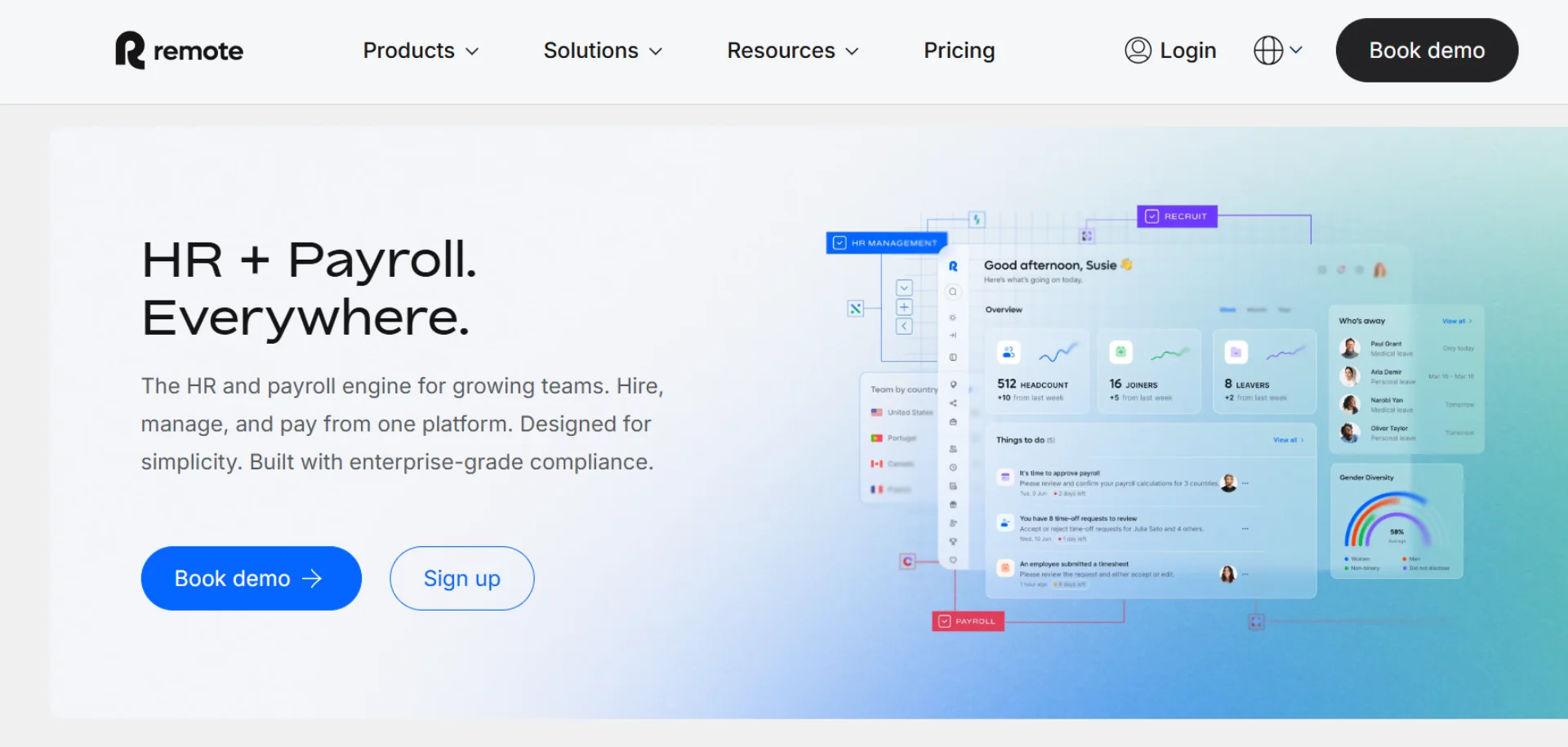
Remote allows startups to onboard and make payments for international talent from over 200 countries, following all compliance. Providing localized contracts, IP protection stock option support tailored to specific regional laws, Remote is unique in offering its core HR suite. It includes time tracking and document storage, which is also free until the startup runs their first payroll.
Topsource

Headquarters: London, UK
Rating: 2.8/5 (G2)
CEO: Ian Larkin
TopSource is a global EOR provider. It provides 24/5 dedicated support to hire talents from over 180 countries. Salary benchmarking to ensure competitive compensation, and global mobility services to relocate talent, are included in ToSource’s services. It protects startups through contractor misclassification audits, providing real-time dashboards for tracking absence and payslips.
Now, let’s look at the best HR services for startups from each strategic HR model.
HR Service | The HR Model | Headquarters | Rating | CEO |
Rippling | HRIS | California | ||
Bamboo HR | HRIS | Utah | ||
TriNet | PEO | California | ||
Insperity | PEO | Texas | ||
Bambee | HRO | California | ||
2080HR | HRO | California | Not Numerical Rating Found Yet | |
Remote | EOR | California | ||
TopSource | EOR | London |
2 Best HRIS Providers
Rippling
Headquarters: San Francisco, California
Rating: 4.8/5 (G2)
CEO: Parker Conrad
Rippling is known as a comprehensive workforce platform. It uniquely unifies the sectors of HR, IT and Finance. Rippling takes care of the automation of high-stake tasks, such as global payroll, device management, app provisioning. Within 90 seconds, this platform can complete these tasks for the new hire. The startup stack of Rippling works like a back-office in a box for venture backed startups. It provides 6 months of free access to help in scaling without operational friction.
BambooHR
Headquarters: Draper, Utah
Rating: 4.4/5 (G2)
CEO: Bradley Rencher
BambooHR is a cloud based platform. It functions as a centralized database for employee records, which makes it ideal for startups who want to professionally manage their culture beyond just payroll. Providing tools for performance management, applicant tracking, and employee engagement surveys, BambooHR is valued for its user-friendly interface. Its easy to use intuitive interface encourages employees to manage their own data and time-off requests.
2 Best PEO Providers
TriNet
Headquarters: Dublin, California
Rating: 4/5 (G2)
CEO: Mike Simonds
Through the pooled buying power that TriNet provides, this co-employment model gives startups access to enterprise-level health benefits. Offering a low cost modular HRIS, TriNet allows startups to add services like payroll and recruiting as they scale. TriNet is designed to handle complex compliance and tax regulations, and reduces the legal burden on the startup.
Insperity
Headquarters: Houston, Texas
Rating: 3.9/5 (G2)
CEO: Paul Sarvadi
Insperity is a full-service PEO emphasizing more on strategic HR partnership rather than only transactional support. Best suited for growing startups with 50 or more employees that require on-site HR support, this platform provides instructor-led training, and comprehensive workforce management. Partnering with platforms like Workday, Insperity offers enhanced HRIS capabilities alongside their professional guidance.
2 Best HRO Providers
Bambee
Headquarters: Los Angeles, California
Rating: 3.5/5 (G2)
CEO: Allan Jones
A specialized HRO focusing intensely on HR compliance and risk management, Bambee is ideal for startups that are building HR infrastructure from the ground up. This platform/provider assigns a dedicated HR manager to each client, who then creates custom HR policies, develops employee handbooks, and navigates complex employment law situations. As it has no set limit for employee number, startups of any size can access Bambee, ensuring compliance with federal and state labor laws.
2080HR
Headquarters: Los Angeles, California
Rating: Not Numerical Rating Found Yet
CEO: Maureen Cheong
2080HR is specifically tailored to the needs of tech startups, providing high touch fractional HR and payroll services. It helps tech founders manage rapid team scaling and provides personalized onboarding support with compliance management. 2080HR allows tech companies to access professional HR guidance and operational support on a fractional basis. This helps in optimizing HR functions during growth phases, without having to hire a full-time department.
2 Best EOR Providers
Remote
Headquarters: San Francisco, California
Rating: 4.5/5 (G2)
CEO: Job van der Voort
Remote allows startups to onboard and make payments for international talent from over 200 countries, following all compliance. Providing localized contracts, IP protection stock option support tailored to specific regional laws, Remote is unique in offering its core HR suite. It includes time tracking and document storage, which is also free until the startup runs their first payroll.
Topsource
Headquarters: London, UK
Rating: 2.8/5 (G2)
CEO: Ian Larkin
TopSource is a global EOR provider. It provides 24/5 dedicated support to hire talents from over 180 countries. Salary benchmarking to ensure competitive compensation, and global mobility services to relocate talent, are included in ToSource’s services. It protects startups through contractor misclassification audits, providing real-time dashboards for tracking absence and payslips.
Must-Have Features for HR Services for Startups
For startups, the right HR service works as an operational backbone. It supports rapid scaling, while founders can focus on their core operations. The must-have features for HR services fall into core operation, talent acquisition, and strategic growth management.
Core Operations and Compliance
Automated Payroll and Tax Filling: This is a critical function that covers automated calculations, direct deposits, and compliance with federal, state and local tax agencies. Keeping the payroll error-free and accurate is important for employee engagement that HR services need to ensure.
Compliance Management: Whilst hiring across multiple different states or countries, startups have to navigate the complexities of labor and employment laws. For this complication, much needed HR service features are automated compliance checks and alerts for changes in minimum wage or overtime rules.
Cloud-based Technology and Self-Service: Cloud based system enables distributed teams to access data from anywhere. The employee self-service portals allow employees to handle tasks such as updating personal information, viewing pay stubs, and requesting time off.
Talent Acquisition and On-Boarding
On-boarding Systems: Startups that aim for rapid growth require efficient and autonomous onboarding systems to automate paperworks, background checks and first day checklists. Along with this, some HR platforms may automate IT provisioning as well.
Applicant Tracking System: A native or integrated ATS with the HR service centralizes job postings, manages candidate pipeline, automating follow-up as well.
AI Powered Screening: Specialized tools integrated with the HR system offer AI driven CV analysis to eliminate unconscious bias and reduce screening time.
Strategic Growth and Culture
Benefits Administration: Through pooled buying power, PEO providers give access to enterprise level administrative benefits for startup employees, such as healthcare benefits.
Performance Management: The HR providers’ built-in tools set goals, track meetings, and help align individual growth with company incentives.
Reporting and Analytics: The HR providers’ detailed reports provide insights into hiring trends, payroll costs and employee engagement. It allows the HR to function as a strategic partner rather than an administrative one.
For startups, the right HR service works as an operational backbone. It supports rapid scaling, while founders can focus on their core operations. The must-have features for HR services fall into core operation, talent acquisition, and strategic growth management.
Core Operations and Compliance
Automated Payroll and Tax Filling: This is a critical function that covers automated calculations, direct deposits, and compliance with federal, state and local tax agencies. Keeping the payroll error-free and accurate is important for employee engagement that HR services need to ensure.
Compliance Management: Whilst hiring across multiple different states or countries, startups have to navigate the complexities of labor and employment laws. For this complication, much needed HR service features are automated compliance checks and alerts for changes in minimum wage or overtime rules.
Cloud-based Technology and Self-Service: Cloud based system enables distributed teams to access data from anywhere. The employee self-service portals allow employees to handle tasks such as updating personal information, viewing pay stubs, and requesting time off.
Talent Acquisition and On-Boarding
On-boarding Systems: Startups that aim for rapid growth require efficient and autonomous onboarding systems to automate paperworks, background checks and first day checklists. Along with this, some HR platforms may automate IT provisioning as well.
Applicant Tracking System: A native or integrated ATS with the HR service centralizes job postings, manages candidate pipeline, automating follow-up as well.
AI Powered Screening: Specialized tools integrated with the HR system offer AI driven CV analysis to eliminate unconscious bias and reduce screening time.
Strategic Growth and Culture
Benefits Administration: Through pooled buying power, PEO providers give access to enterprise level administrative benefits for startup employees, such as healthcare benefits.
Performance Management: The HR providers’ built-in tools set goals, track meetings, and help align individual growth with company incentives.
Reporting and Analytics: The HR providers’ detailed reports provide insights into hiring trends, payroll costs and employee engagement. It allows the HR to function as a strategic partner rather than an administrative one.
For startups, the right HR service works as an operational backbone. It supports rapid scaling, while founders can focus on their core operations. The must-have features for HR services fall into core operation, talent acquisition, and strategic growth management.
Core Operations and Compliance
Automated Payroll and Tax Filling: This is a critical function that covers automated calculations, direct deposits, and compliance with federal, state and local tax agencies. Keeping the payroll error-free and accurate is important for employee engagement that HR services need to ensure.
Compliance Management: Whilst hiring across multiple different states or countries, startups have to navigate the complexities of labor and employment laws. For this complication, much needed HR service features are automated compliance checks and alerts for changes in minimum wage or overtime rules.
Cloud-based Technology and Self-Service: Cloud based system enables distributed teams to access data from anywhere. The employee self-service portals allow employees to handle tasks such as updating personal information, viewing pay stubs, and requesting time off.
Talent Acquisition and On-Boarding
On-boarding Systems: Startups that aim for rapid growth require efficient and autonomous onboarding systems to automate paperworks, background checks and first day checklists. Along with this, some HR platforms may automate IT provisioning as well.
Applicant Tracking System: A native or integrated ATS with the HR service centralizes job postings, manages candidate pipeline, automating follow-up as well.
AI Powered Screening: Specialized tools integrated with the HR system offer AI driven CV analysis to eliminate unconscious bias and reduce screening time.
Strategic Growth and Culture
Benefits Administration: Through pooled buying power, PEO providers give access to enterprise level administrative benefits for startup employees, such as healthcare benefits.
Performance Management: The HR providers’ built-in tools set goals, track meetings, and help align individual growth with company incentives.
Reporting and Analytics: The HR providers’ detailed reports provide insights into hiring trends, payroll costs and employee engagement. It allows the HR to function as a strategic partner rather than an administrative one.
For startups, the right HR service works as an operational backbone. It supports rapid scaling, while founders can focus on their core operations. The must-have features for HR services fall into core operation, talent acquisition, and strategic growth management.
Core Operations and Compliance
Automated Payroll and Tax Filling: This is a critical function that covers automated calculations, direct deposits, and compliance with federal, state and local tax agencies. Keeping the payroll error-free and accurate is important for employee engagement that HR services need to ensure.
Compliance Management: Whilst hiring across multiple different states or countries, startups have to navigate the complexities of labor and employment laws. For this complication, much needed HR service features are automated compliance checks and alerts for changes in minimum wage or overtime rules.
Cloud-based Technology and Self-Service: Cloud based system enables distributed teams to access data from anywhere. The employee self-service portals allow employees to handle tasks such as updating personal information, viewing pay stubs, and requesting time off.
Talent Acquisition and On-Boarding
On-boarding Systems: Startups that aim for rapid growth require efficient and autonomous onboarding systems to automate paperworks, background checks and first day checklists. Along with this, some HR platforms may automate IT provisioning as well.
Applicant Tracking System: A native or integrated ATS with the HR service centralizes job postings, manages candidate pipeline, automating follow-up as well.
AI Powered Screening: Specialized tools integrated with the HR system offer AI driven CV analysis to eliminate unconscious bias and reduce screening time.
Strategic Growth and Culture
Benefits Administration: Through pooled buying power, PEO providers give access to enterprise level administrative benefits for startup employees, such as healthcare benefits.
Performance Management: The HR providers’ built-in tools set goals, track meetings, and help align individual growth with company incentives.
Reporting and Analytics: The HR providers’ detailed reports provide insights into hiring trends, payroll costs and employee engagement. It allows the HR to function as a strategic partner rather than an administrative one.
Conclusion
To transform Human Resource from an administrative burden to an operational backbone, a startup needs to be strategic in selecting the best HR service. Whether you prioritize payroll simplicity, global infrastructure, or unified automation, the goal is to save time for core innovation. Startups can avoid legal errors and administrative overload by automating high stake tasks like compliance and onboarding. Nonetheless, if the chosen platform can scale with the business, it can provide a professional infrastructure to the business to support a growing team.
To transform Human Resource from an administrative burden to an operational backbone, a startup needs to be strategic in selecting the best HR service. Whether you prioritize payroll simplicity, global infrastructure, or unified automation, the goal is to save time for core innovation. Startups can avoid legal errors and administrative overload by automating high stake tasks like compliance and onboarding. Nonetheless, if the chosen platform can scale with the business, it can provide a professional infrastructure to the business to support a growing team.
Frequently Asked Questions
When should a startup implement an HR system?
As soon as a startup starts hiring multiple employees and contractors, they should be implementing the HR system to establish efficient workflow, automate high-stake works like payroll and tax fillings, and ensure compliance.
How are PEO and EOR different from each other?
PEO operates on a co-employment basis and provides small teams with access to enterprise-level benefits. On the other hand, EOR is for international hiring, allowing startups to employ and pay talents from foreign countries.
Why choose fractional HR instead of full-time HR?
A full-time HR director costs more than 100s of thousands of dollars annually which is not cost effective and a budget mismatch. Fractional HR provides part-time contract basis HR leadership being more budget friendly.
What can be the potential downside of using traditional PEO?
The potential of losing the control of your company data is a downside of traditional PEO. PEOs can also become expensive as the company grows, because they typically charge a percentage of the company payroll.
When should a startup implement an HR system?
As soon as a startup starts hiring multiple employees and contractors, they should be implementing the HR system to establish efficient workflow, automate high-stake works like payroll and tax fillings, and ensure compliance.
How are PEO and EOR different from each other?
PEO operates on a co-employment basis and provides small teams with access to enterprise-level benefits. On the other hand, EOR is for international hiring, allowing startups to employ and pay talents from foreign countries.
Why choose fractional HR instead of full-time HR?
A full-time HR director costs more than 100s of thousands of dollars annually which is not cost effective and a budget mismatch. Fractional HR provides part-time contract basis HR leadership being more budget friendly.
What can be the potential downside of using traditional PEO?
The potential of losing the control of your company data is a downside of traditional PEO. PEOs can also become expensive as the company grows, because they typically charge a percentage of the company payroll.

Noshin Nisa
Noshin Nisa
Noshin Nisa
Content Writer
Content Writer
I make sure readers get to know what I can help them know through my words and understanding.
I make sure readers get to know what I can help them know through my words and understanding.
I make sure readers get to know what I can help them know through my words and understanding.
Get a Free SEO Growth Plan
Get a Free SEO Growth Plan
Get a Free SEO Growth Plan
Share on social media
Share on social media
Share on social media