How to Choose the Right SEO Platform for a Scalable Organic Growth Strategy
How to Choose the Right SEO Platform for a Scalable Organic Growth Strategy
How to Choose the Right SEO Platform for a Scalable Organic Growth Strategy
TL;DR
Look beyond individual features: A good SEO platform should cover the full SEO workflow rather than excel at just one task.
Think about where your business is heading: The platform you choose should be able to handle more websites, keywords, users, markets, and SEO work as you grow.
Test before you commit: Compare the platform's data with Google Search Console, let your team try real tasks, and see how well the reporting works in practice.
Calculate the long-term cost: A low starting price can be misleading, so check how expenses change when you add users, projects, keywords, domains, or other resources.
Choosing an SEO platform often looks like a simple software purchase. A handy tool may work well when one or two people manage your SEO function, but it may quickly become a bottleneck when your company grows quickly.
The complexity of your SEO setup grows with your company. When you add websites, enter new markets, hire new team members, and try to prepare for the tsunami of AI search requirements, you need a different, scalable SEO software tool.
The market of SEO platforms is huge. Without experienced guidance, it’s easy to get lost and make the wrong choice. Stay on the pages of this guide to learn how to choose an SEO platform that fits your business at every stage of growth.
What Is an SEO Platform?
An SEO platform is a software solution that brings multiple search engine optimization capabilities into one place. Instead of switching between separate SEO tools for keyword research, rank tracking, backlink analysis, competitor insights, and technical audits, internal SEO teams and external consultants can manage much of their workflow through a single platform.
An SEO platform is a software solution that brings multiple search engine optimization capabilities into one place. Instead of switching between separate SEO tools for keyword research, rank tracking, backlink analysis, competitor insights, and technical audits, internal SEO teams and external consultants can manage much of their workflow through a single platform.
What to Look for in an SEO Platform
A worthy SEO platform rarely emphasizes one particular search engine optimization aspect. If you see a narrow focus (e.g., live rank tracking or technical SEO audit) stated as a motto on the main page, it would probably make sense to walk away from such a narrow capability.
What you should be looking for instead is a broad, comprehensive scope clearly reflected in the main mission or vision. An interesting ambition may look like:
“We give SEO teams everything they need to understand search, outperform competitors, and grow their organic visibility.”
Or this one:
“Make complex SEO data actionable so businesses can build, scale, and continuously improve their organic search performance.”
A good real example is what Moz states in its website:

Source: Moz
That’s on the surface, of course. Deep down the hood, when you start carefully researching the platform and talking to its representatives, you should be looking for the following capabilities:
Keyword research to discover search terms, estimate demand, and assess ranking difficulty.
Rank tracking to monitor keyword positions across search engines, locations, and devices.
Competitor analysis to identify competitors' keywords, backlinks, content, and organic visibility.
Backlink analysis to evaluate a site's backlink profile and discover link-building opportunities.
Reporting and analytics to turn SEO data into reporting dashboards for teams, clients, or executives.
There’s also a less obvious question to ask: “Who will see the platform?” If you’re an agency working with multiple clients, white label SEO software may be worth considering because it can make the client-facing side of SEO feel like a natural extension of your own service rather than a third-party tool.
The bottom line: An SEO platform for scalable organic growth strategy must be equally good at technical, on-page, and off-page SEO. It must be native to AI search, able to drive visibility and mentions in generative AI engines.
A worthy SEO platform rarely emphasizes one particular search engine optimization aspect. If you see a narrow focus (e.g., live rank tracking or technical SEO audit) stated as a motto on the main page, it would probably make sense to walk away from such a narrow capability.
What you should be looking for instead is a broad, comprehensive scope clearly reflected in the main mission or vision. An interesting ambition may look like:
“We give SEO teams everything they need to understand search, outperform competitors, and grow their organic visibility.”
Or this one:
“Make complex SEO data actionable so businesses can build, scale, and continuously improve their organic search performance.”
A good real example is what Moz states in its website:
Source: Moz
That’s on the surface, of course. Deep down the hood, when you start carefully researching the platform and talking to its representatives, you should be looking for the following capabilities:
Keyword research to discover search terms, estimate demand, and assess ranking difficulty.
Rank tracking to monitor keyword positions across search engines, locations, and devices.
Competitor analysis to identify competitors' keywords, backlinks, content, and organic visibility.
Backlink analysis to evaluate a site's backlink profile and discover link-building opportunities.
Reporting and analytics to turn SEO data into reporting dashboards for teams, clients, or executives.
There’s also a less obvious question to ask: “Who will see the platform?” If you’re an agency working with multiple clients, white label SEO software may be worth considering because it can make the client-facing side of SEO feel like a natural extension of your own service rather than a third-party tool.
The bottom line: An SEO platform for scalable organic growth strategy must be equally good at technical, on-page, and off-page SEO. It must be native to AI search, able to drive visibility and mentions in generative AI engines.
Best SEO Platforms for Scalable Organic Growth
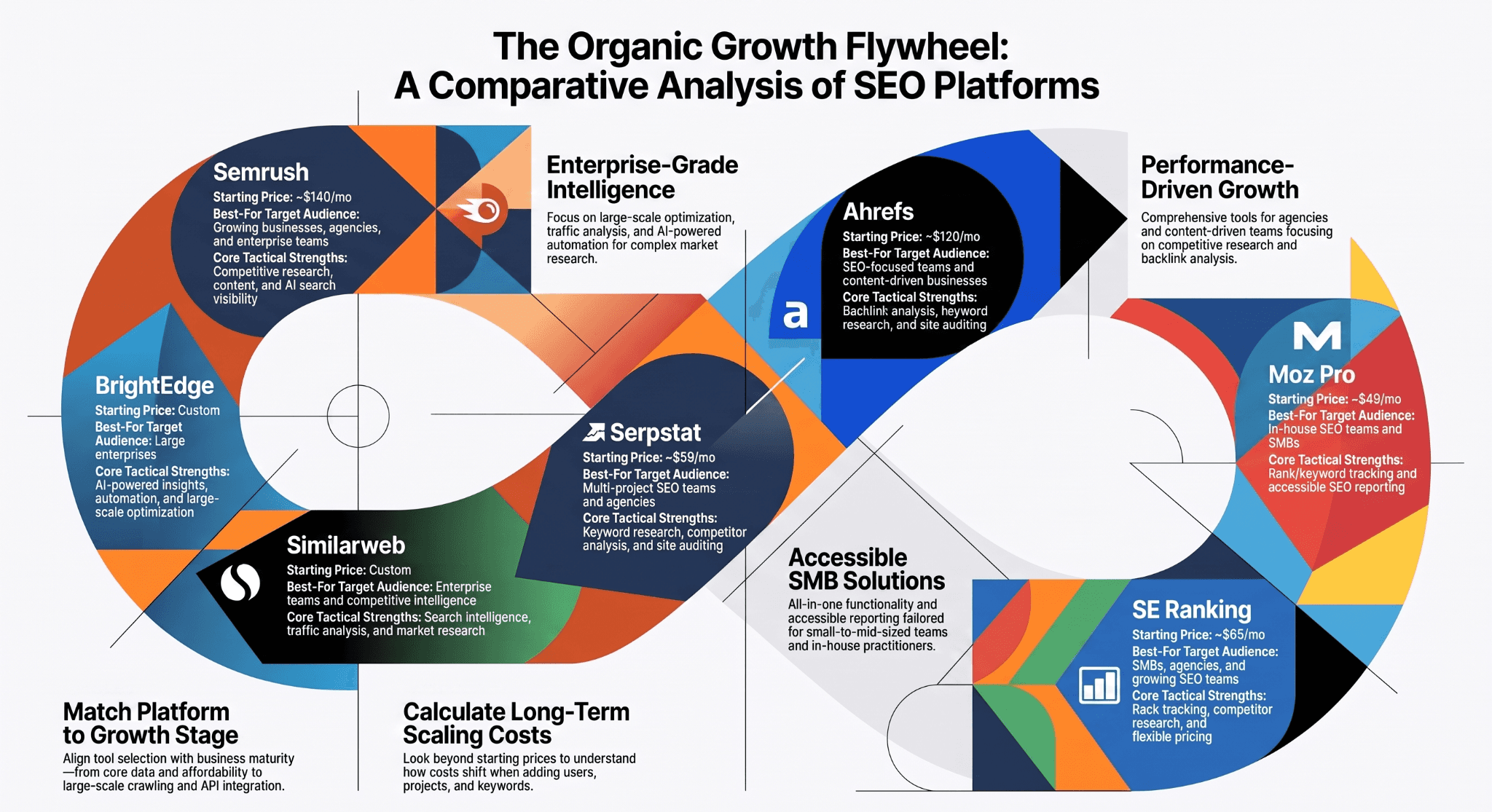
Here are some of the best tools for SEO optimization on the market that are ideally suited for scalable organic growth. All of them are pretty versatile, but they come with some unique strengths, which we reflected in the relevant column titled “Key strengths”.
One important note: Don’t let the price column mislead you. Even though the price is an important factor, it shouldn't imply that the cheapest platform is the best choice for a growing SEO operation.
In fact, the next chapter, focusing on the 5-step evaluation framework for your decision, will explain why a real, scaling price is more important than the prices that we typically find in the headlines.
SEO platform | Best for | Key strengths | Starting price |
Semrush | Growing businesses, agencies, and enterprise teams | Comprehensive SEO, competitive research, content, reporting, and AI search visibility | From ~$140/mo |
Ahrefs | SEO-focused teams and content-driven businesses | Backlink analysis, keyword research, competitive analysis, and site auditing | From ~$129/mo |
SE Ranking | SMBs, agencies, and growing SEO teams | Strong all-in-one functionality, rank tracking, competitor research, and flexible pricing | From ~$65/mo |
Moz Pro | In-house SEO teams and SMBs | Rank and keyword tracking, site audits, and accessible SEO reporting | From ~$49/mo |
Serpstat | SEO teams and agencies managing multiple projects | Keyword research, competitor analysis, rank tracking, and site auditing | From ~$59/mo |
Similarweb | Enterprise teams and competitive intelligence | Search intelligence, traffic analysis, market research, and competitor insights | Custom / varies |
BrightEdge | Large enterprises | Enterprise SEO, AI-powered insights, automation, reporting, and large-scale optimization | Custom |
Here are some of the best tools for SEO optimization on the market that are ideally suited for scalable organic growth. All of them are pretty versatile, but they come with some unique strengths, which we reflected in the relevant column titled “Key strengths”.
One important note: Don’t let the price column mislead you. Even though the price is an important factor, it shouldn't imply that the cheapest platform is the best choice for a growing SEO operation.
In fact, the next chapter, focusing on the 5-step evaluation framework for your decision, will explain why a real, scaling price is more important than the prices that we typically find in the headlines.
SEO platform | Best for | Key strengths | Starting price |
Semrush | Growing businesses, agencies, and enterprise teams | Comprehensive SEO, competitive research, content, reporting, and AI search visibility | From ~$140/mo |
Ahrefs | SEO-focused teams and content-driven businesses | Backlink analysis, keyword research, competitive analysis, and site auditing | From ~$129/mo |
SE Ranking | SMBs, agencies, and growing SEO teams | Strong all-in-one functionality, rank tracking, competitor research, and flexible pricing | From ~$65/mo |
Moz Pro | In-house SEO teams and SMBs | Rank and keyword tracking, site audits, and accessible SEO reporting | From ~$49/mo |
Serpstat | SEO teams and agencies managing multiple projects | Keyword research, competitor analysis, rank tracking, and site auditing | From ~$59/mo |
Similarweb | Enterprise teams and competitive intelligence | Search intelligence, traffic analysis, market research, and competitor insights | Custom / varies |
BrightEdge | Large enterprises | Enterprise SEO, AI-powered insights, automation, reporting, and large-scale optimization | Custom |
How to Match an SEO Platform to Your Growth Stage
Besides the ease of creation and launch, companies these days grow and die faster than ever. Needless to say, the ideal SEO software tool at each growth stage would be slightly different.
What worked well when your website was only 30 pages long may become inefficient once the site reaches thousands of pages.
Here is a simple framework to help you match an SEO platform to your growth stage:
Growth stage | What matters most |
Early-stage / small website | Core SEO data, ease of use, affordability |
Growing business | Automation, competitor research, reporting |
Scaling SaaS/enterprise | Large-scale crawling, APIs, integrations, collaboration, governance |
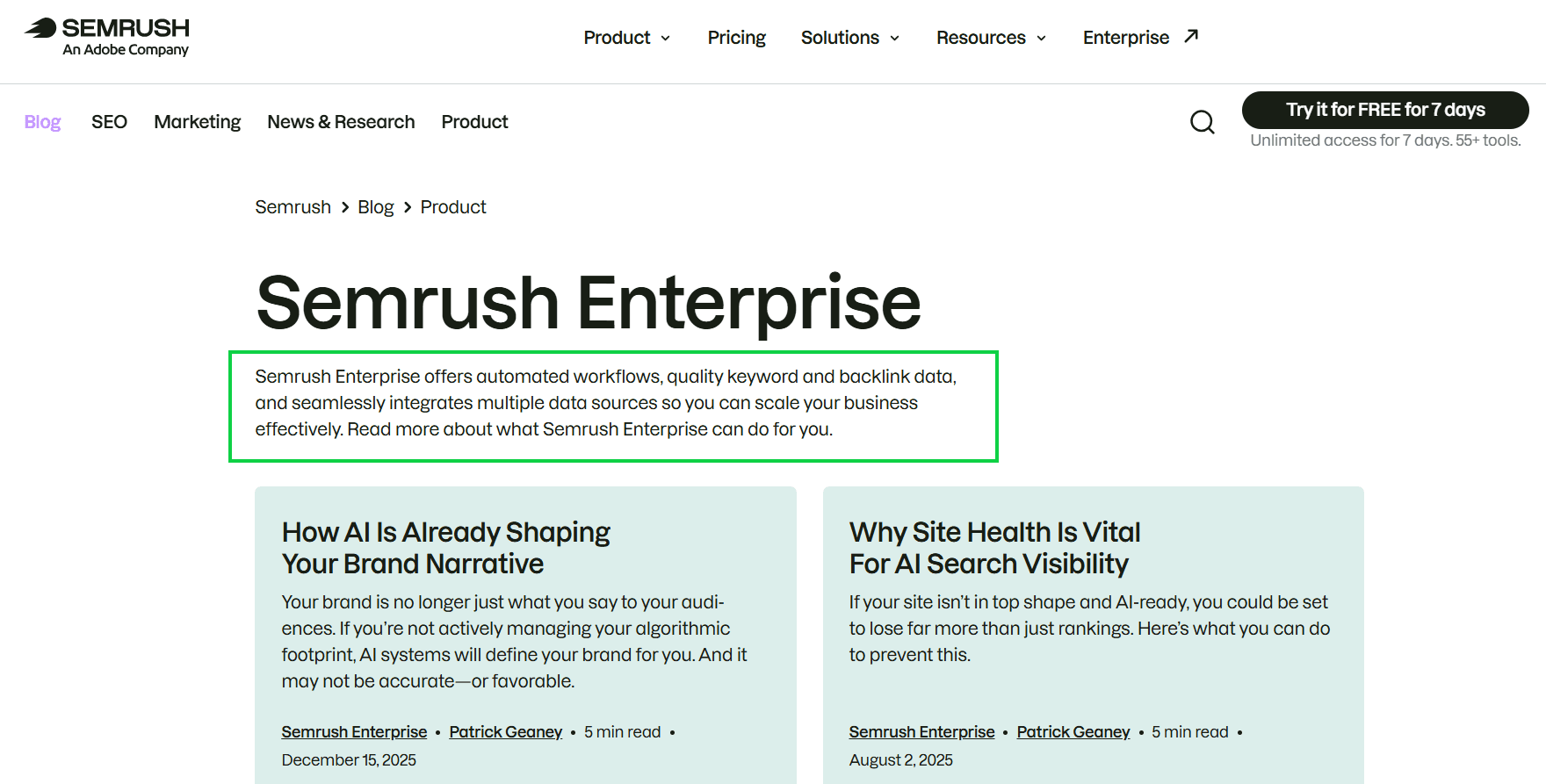
Some of the platform’s capabilities that your business will need may not be explicitly stated in the subscription plan. You need to do some serious research and ideally try using a tool for a trial period to find what it’s really capable of.
Others, like Semrush, explicitly include this capability in their high-tier plans:
Source: Semrush
Besides the ease of creation and launch, companies these days grow and die faster than ever. Needless to say, the ideal SEO software tool at each growth stage would be slightly different.
What worked well when your website was only 30 pages long may become inefficient once the site reaches thousands of pages.
Here is a simple framework to help you match an SEO platform to your growth stage:
Growth stage | What matters most |
Early-stage / small website | Core SEO data, ease of use, affordability |
Growing business | Automation, competitor research, reporting |
Scaling SaaS/enterprise | Large-scale crawling, APIs, integrations, collaboration, governance |
Some of the platform’s capabilities that your business will need may not be explicitly stated in the subscription plan. You need to do some serious research and ideally try using a tool for a trial period to find what it’s really capable of.
Others, like Semrush, explicitly include this capability in their high-tier plans:
Source: Semrush
5-Step Evaluation Framework for Your Decision
Since you’ll most likely be considering multiple options before making a final choice, you’ll need a systematic approach to evaluate each option equally well.
The following five-step evaluation framework will help you do so and separate the platforms that look good on paper from those that work well in practice.
1. Test Data Accuracy Against Google Search Console
The first and very simple evaluation of the SEO tool’s performance is to see how reliable its data actually is. No third-party tool can be as accurate as the source, i.e., Google itself.
If you haven’t done so, take your favorite SEO platform and compare its data with your Search Console data. Measure and check impressions, clicks, rankings, and other available metrics across a representative set of pages and queries. Let the measurement run for some time, for hours and days.
Slight discrepancies are normal, but if you see big differences over a large period of time, that’s a good reason to reconsider your choice. Maybe this SEO software tool isn’t the best fit for your business decisions?
2. Calculate Scaling Costs and Seat Limits
Don’t get yourself misguided by the headline and trial period price of a tool. What you actually need to understand is how the price will change with your growing needs.
For that, try to answer the following questions:
Will the software you choose be as affordable in one or two years when your business grows?
Are there any hidden costs that your current subscription/contract didn’t take into account?
In particular, calculate what the platform will cost when your SEO operation grows. Check limits on users, projects, domains, keyword tracking, crawls, historical data, and other resources.
3. Run Team Trial Sessions
The best way to evaluate the platform’s performance is to actually use and test it. Most platforms have trial periods, but even if they don’t, corporate and enterprise users can always negotiate to have one.
Your team members, the people who will be using this SEO platform, should have a clear say in this process. So, give your content writers, technical SEOs, strategists, and other relevant team members access during the trial period. Ask them to complete real tasks rather than simply explore the interface:
How quickly can they find the information they need?
How many steps does a typical workflow require?
Does this platform allow them to complete tasks with greater efficiency and speed?
Usually, big surprises come at this stage, as what a platform openly advertises, given all features and technical capabilities, may not correlate with the results of testing.
4. Review Reporting Flexibility
The reports that your future platform will generate will be consumed by a variety of stakeholders, the majority of whom won’t necessarily be SEO geeks. Your clients, executives, content teams, and other stakeholders may all need SEO reporting, and they all will have different views of the same information.
So, test the platform’s reporting and dashboard capabilities in real-life situations. Check whether the tool will allow you to automate reports, customize the metrics displayed, apply appropriate filters, and most importantly, present complex SEO data in a way that non-specialists can understand.
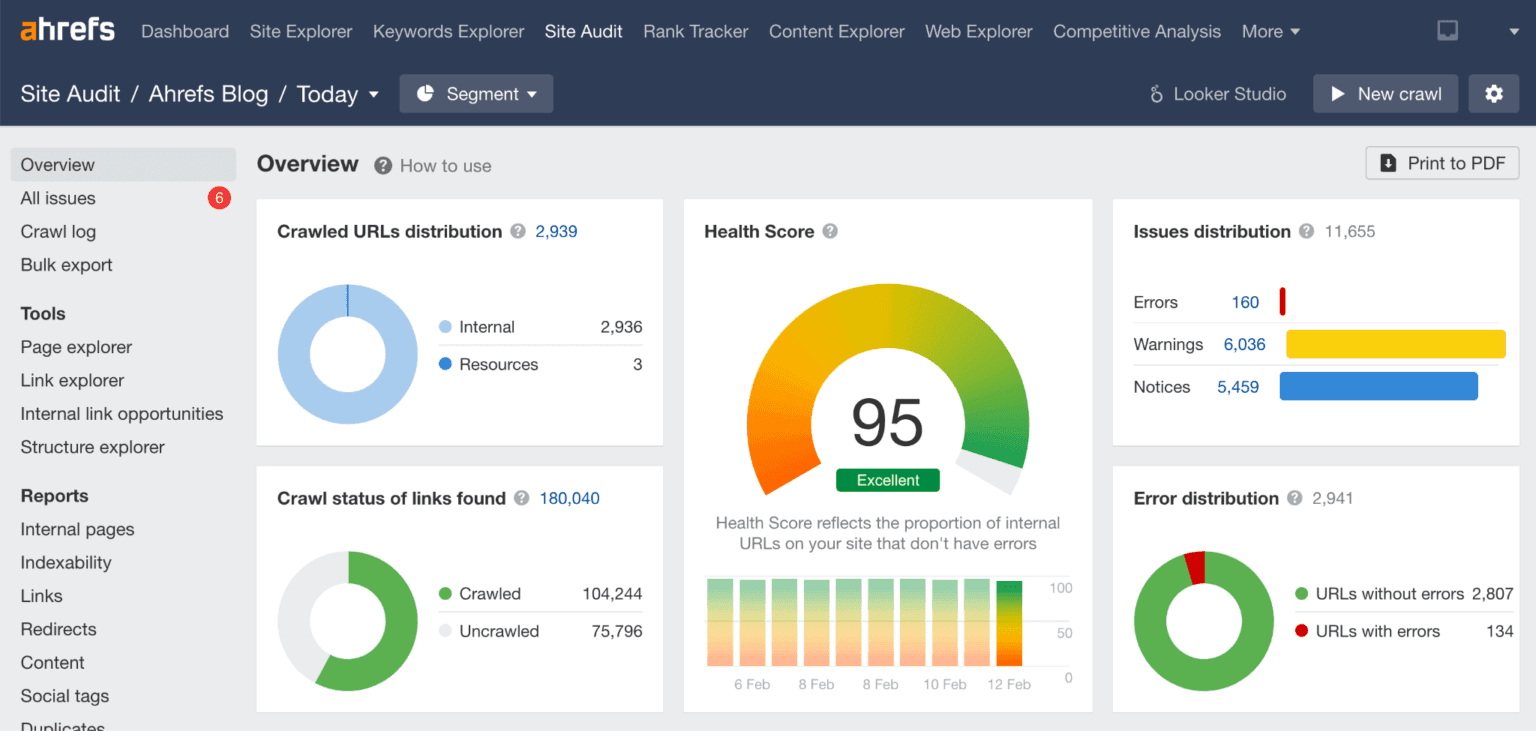
Source: Ahrefs
5. Check Support and Documentation
At the final step, consider what happens after the trial period ends. Will the platform provide as good customer support as during the trial period? Will they be as flexible and cooperative with your demands, requests for special reports and information, generative engine optimization, and with solving your scaling problems?
Of course, you may not be able to accurately evaluate these things while you’re still in the trial period. But you can have an educated look into these capabilities by carefully reviewing the platform’s knowledge base, tutorials, technical files, and API resources.
For larger SEO operations, account management and technical support can become important factors in the overall value of the platform.
Since you’ll most likely be considering multiple options before making a final choice, you’ll need a systematic approach to evaluate each option equally well.
The following five-step evaluation framework will help you do so and separate the platforms that look good on paper from those that work well in practice.
1. Test Data Accuracy Against Google Search Console
The first and very simple evaluation of the SEO tool’s performance is to see how reliable its data actually is. No third-party tool can be as accurate as the source, i.e., Google itself.
If you haven’t done so, take your favorite SEO platform and compare its data with your Search Console data. Measure and check impressions, clicks, rankings, and other available metrics across a representative set of pages and queries. Let the measurement run for some time, for hours and days.
Slight discrepancies are normal, but if you see big differences over a large period of time, that’s a good reason to reconsider your choice. Maybe this SEO software tool isn’t the best fit for your business decisions?
2. Calculate Scaling Costs and Seat Limits
Don’t get yourself misguided by the headline and trial period price of a tool. What you actually need to understand is how the price will change with your growing needs.
For that, try to answer the following questions:
Will the software you choose be as affordable in one or two years when your business grows?
Are there any hidden costs that your current subscription/contract didn’t take into account?
In particular, calculate what the platform will cost when your SEO operation grows. Check limits on users, projects, domains, keyword tracking, crawls, historical data, and other resources.
3. Run Team Trial Sessions
The best way to evaluate the platform’s performance is to actually use and test it. Most platforms have trial periods, but even if they don’t, corporate and enterprise users can always negotiate to have one.
Your team members, the people who will be using this SEO platform, should have a clear say in this process. So, give your content writers, technical SEOs, strategists, and other relevant team members access during the trial period. Ask them to complete real tasks rather than simply explore the interface:
How quickly can they find the information they need?
How many steps does a typical workflow require?
Does this platform allow them to complete tasks with greater efficiency and speed?
Usually, big surprises come at this stage, as what a platform openly advertises, given all features and technical capabilities, may not correlate with the results of testing.
4. Review Reporting Flexibility
The reports that your future platform will generate will be consumed by a variety of stakeholders, the majority of whom won’t necessarily be SEO geeks. Your clients, executives, content teams, and other stakeholders may all need SEO reporting, and they all will have different views of the same information.
So, test the platform’s reporting and dashboard capabilities in real-life situations. Check whether the tool will allow you to automate reports, customize the metrics displayed, apply appropriate filters, and most importantly, present complex SEO data in a way that non-specialists can understand.
Source: Ahrefs
5. Check Support and Documentation
At the final step, consider what happens after the trial period ends. Will the platform provide as good customer support as during the trial period? Will they be as flexible and cooperative with your demands, requests for special reports and information, generative engine optimization, and with solving your scaling problems?
Of course, you may not be able to accurately evaluate these things while you’re still in the trial period. But you can have an educated look into these capabilities by carefully reviewing the platform’s knowledge base, tutorials, technical files, and API resources.
For larger SEO operations, account management and technical support can become important factors in the overall value of the platform.
The Final Word: Choose for the Future, Not Today
The best SEO platform is not necessarily the one that fits your business today, but the one that won't become a limitation tomorrow.
Most popular SEO platforms are great for basic tasks of ranking optimization, competitor research, keyword strategy, and technical website performance. However, the key question to answer is whether the platform will be as good at tackling your future SEO needs as your business grows and scales.
One important aspect here is the scaling capabilities, and another no less important aspect is the platform’s ability to meet your specific needs and demands. You should build your selection process around answering these key questions before committing to a SEO ranking software for the long term.
The best SEO platform is not necessarily the one that fits your business today, but the one that won't become a limitation tomorrow.
Most popular SEO platforms are great for basic tasks of ranking optimization, competitor research, keyword strategy, and technical website performance. However, the key question to answer is whether the platform will be as good at tackling your future SEO needs as your business grows and scales.
One important aspect here is the scaling capabilities, and another no less important aspect is the platform’s ability to meet your specific needs and demands. You should build your selection process around answering these key questions before committing to a SEO ranking software for the long term.
FAQ
1. What features should you look for in an SEO platform?
Start with the essentials: keyword research, rank tracking, competitor and backlink analysis, technical SEO, and reporting. For a growing SEO operation, automation, integrations, reliable data, and AI search capabilities matter too.
2. How much should you spend on SEO optimization tools?
Don’t base your budget on the cheapest plan you can find. Think about what the platform will cost as you add users, websites, keywords, projects, and other resources over time.
3. How can you tell if an SEO platform is right for your team?
Give your team a chance to use the platform on real SEO tasks before you commit. Pay attention to how quickly people get things done, how trustworthy the data feels, and whether the reporting actually works for your stakeholders.
4. What is the best SEO platform for scalable organic growth?
There’s no single SEO platform that works equally well for every business. The right choice depends on your site size, team, markets, workflow, budget, and where you expect your SEO program to go.
1. What features should you look for in an SEO platform?
Start with the essentials: keyword research, rank tracking, competitor and backlink analysis, technical SEO, and reporting. For a growing SEO operation, automation, integrations, reliable data, and AI search capabilities matter too.
2. How much should you spend on SEO optimization tools?
Don’t base your budget on the cheapest plan you can find. Think about what the platform will cost as you add users, websites, keywords, projects, and other resources over time.
3. How can you tell if an SEO platform is right for your team?
Give your team a chance to use the platform on real SEO tasks before you commit. Pay attention to how quickly people get things done, how trustworthy the data feels, and whether the reporting actually works for your stakeholders.
4. What is the best SEO platform for scalable organic growth?
There’s no single SEO platform that works equally well for every business. The right choice depends on your site size, team, markets, workflow, budget, and where you expect your SEO program to go.

Saleh Ahmed
Saleh Ahmed
Saleh Ahmed
Founder, Rank Wizards
Founder, Rank Wizards
Saleh is an SEO consultant specialising in semantic SEO and generative-engine optimisation. Father of a daughter, ameteur pinpong player.
Saleh is an SEO consultant specialising in semantic SEO and generative-engine optimisation. Father of a daughter, ameteur pinpong player.
Saleh is an SEO consultant specialising in semantic SEO and generative-engine optimisation. Father of a daughter, ameteur pinpong player.
Get a Free SEO Growth Plan
Get a Free SEO Growth Plan
Get a Free SEO Growth Plan
Share on social media
Share on social media
Share on social media