SaaS SEO strategy

SEO Strategy for SaaS
SaaS SEO strategy

SEO Strategy for SaaS

SaaS SEO strategy

SEO Strategy for SaaS

Summarize with AI

Sep 15, 2025

2 min read

TL;DR

Did you know that according to a recent study, 92% of SaaS startups fail within 3 years of launch? Your SaaS company is one of the many SaaS companies out there trying to survive in the market with the competition of visibility. Not only this, 73% of SaaS startups fail to hit their first $1M ARR over its lifespan. Yes, the struggle is real. You can’t always rely on paid ads or superficial promotional methods for genuine visibility. To gain eyeballs from niche specific relevant audiences, your strategy needs to be strong and genuine also. For that you need to implement search engine optimization for getting interaction from genuine and relevant people. Unlike the paid ad strategy, SEO strategy in SaaS sustains. SEO in SaaS is not just chasing traffic like traditional SEO. For SaaS, SEO is about gaining market qualified leads (MQL), the leads that will possibly convert and sign up. This blog will be discussing proven and workable strategies of SEO for SaaS, and how we as a SaaS SEO agency implement those strategies.

What is SaaS SEO?

For SaaS SEO, you optimize your website, online content and overall online presence to rank in Google search engine, so that the right audience finds you against the relevant keywords. 

However, SEO for SaaS is much deeper than simply ranking with keywords. 

The things SaaS SEO works on are:

  • ICP (Ideal Customer Profile) making, for targeting the exact type of traffic who will eventually convert.

  • Creating or guiding to create educational top of the funnel content, solution based middle of the funnel content, and demo and transaction driven bottom of the funnel content, all with the intention to lead the acquired traffic towards conversion. 

  • Keeping the product feature page, case study page, content page etc optimized for easy discovery on Google.

  • Maintaining continuity. This process aims to keep bringing up sign-ups, conversions and demos by making sure that your company website shows up where the customers and searchers need it. 

  • Helps you reduce cost per acquisition in contrary of PPC or other social media paid ads

For SaaS SEO, you optimize your website, online content and overall online presence to rank in Google search engine, so that the right audience finds you against the relevant keywords. 

However, SEO for SaaS is much deeper than simply ranking with keywords. 

The things SaaS SEO works on are:

  • ICP (Ideal Customer Profile) making, for targeting the exact type of traffic who will eventually convert.

  • Creating or guiding to create educational top of the funnel content, solution based middle of the funnel content, and demo and transaction driven bottom of the funnel content, all with the intention to lead the acquired traffic towards conversion. 

  • Keeping the product feature page, case study page, content page etc optimized for easy discovery on Google.

  • Maintaining continuity. This process aims to keep bringing up sign-ups, conversions and demos by making sure that your company website shows up where the customers and searchers need it. 

  • Helps you reduce cost per acquisition in contrary of PPC or other social media paid ads

For SaaS SEO, you optimize your website, online content and overall online presence to rank in Google search engine, so that the right audience finds you against the relevant keywords. 

However, SEO for SaaS is much deeper than simply ranking with keywords. 

The things SaaS SEO works on are:

  • ICP (Ideal Customer Profile) making, for targeting the exact type of traffic who will eventually convert.

  • Creating or guiding to create educational top of the funnel content, solution based middle of the funnel content, and demo and transaction driven bottom of the funnel content, all with the intention to lead the acquired traffic towards conversion. 

  • Keeping the product feature page, case study page, content page etc optimized for easy discovery on Google.

  • Maintaining continuity. This process aims to keep bringing up sign-ups, conversions and demos by making sure that your company website shows up where the customers and searchers need it. 

  • Helps you reduce cost per acquisition in contrary of PPC or other social media paid ads

The Importance of SEO in SaaS

SEO is reliable for SaaS in bringing in customers. 

SEO increases the chances of your website or company getting reached to people who need your service. It helps people find you when they are looking for solutions or comparing websites. Better SEO increases your possibility to get chosen as well. 

Let’s see how:

  • SEO reduces the customer acquisition cost (CPA). In contrast to paid ads that cost more with increasing competition, SEO reduces the expense, because as you rank, you gain more leads without having to pay for ads. 

  • SaaS buyers don’t convert easily. They have to study and research about your SaaS for them to decide what they pick. Search engine optimized content and website educate your audience to make their research easier, making it possible for you to get chosen.

  • SaaS SEO plays a massive role in omni-channel marketing by building brand awareness and topical authority. 

SEO is reliable for SaaS in bringing in customers. 

SEO increases the chances of your website or company getting reached to people who need your service. It helps people find you when they are looking for solutions or comparing websites. Better SEO increases your possibility to get chosen as well. 

Let’s see how:

  • SEO reduces the customer acquisition cost (CPA). In contrast to paid ads that cost more with increasing competition, SEO reduces the expense, because as you rank, you gain more leads without having to pay for ads. 

  • SaaS buyers don’t convert easily. They have to study and research about your SaaS for them to decide what they pick. Search engine optimized content and website educate your audience to make their research easier, making it possible for you to get chosen.

  • SaaS SEO plays a massive role in omni-channel marketing by building brand awareness and topical authority. 

SEO is reliable for SaaS in bringing in customers. 

SEO increases the chances of your website or company getting reached to people who need your service. It helps people find you when they are looking for solutions or comparing websites. Better SEO increases your possibility to get chosen as well. 

Let’s see how:

  • SEO reduces the customer acquisition cost (CPA). In contrast to paid ads that cost more with increasing competition, SEO reduces the expense, because as you rank, you gain more leads without having to pay for ads. 

  • SaaS buyers don’t convert easily. They have to study and research about your SaaS for them to decide what they pick. Search engine optimized content and website educate your audience to make their research easier, making it possible for you to get chosen.

  • SaaS SEO plays a massive role in omni-channel marketing by building brand awareness and topical authority. 

SaaS SEO vs Traditional SEO: The Difference and Comparison

Though SEO seems the same for every business, SaaS SEO is different from traditional SEO in terms of intent and performance. Let’s discuss the difference. 

  • The research method for SaaS SEO and traditional SEO varies. Traditionally, research is done on high volume keywords that are also generic. For SaaS, intent matters more than volume, having to do research with high-intent keywords.

  • For funnel positioning, traditional SEO prioritizes top of the funnel target. But SaaS SEO aims for the full funnel, ultimately focusing on conversion and retention.

  • Traditionally, SEO prioritizes website traffic, ranking and bounce rates. SaaS SEO remains practical, prioritizing signups, transactions and churn rates. 

  • Traditional SEO maps content based on keywords only. But for SaaS, content mapping varies in terms of funnel stages, personas and product features. 

Traditional SEO assumes a linear and straightforward path for the buyer’s journey. For SaaS, the buyer’s journey is complicated, requiring multiple decision making steps in between.

Though SEO seems the same for every business, SaaS SEO is different from traditional SEO in terms of intent and performance. Let’s discuss the difference. 

  • The research method for SaaS SEO and traditional SEO varies. Traditionally, research is done on high volume keywords that are also generic. For SaaS, intent matters more than volume, having to do research with high-intent keywords.

  • For funnel positioning, traditional SEO prioritizes top of the funnel target. But SaaS SEO aims for the full funnel, ultimately focusing on conversion and retention.

  • Traditionally, SEO prioritizes website traffic, ranking and bounce rates. SaaS SEO remains practical, prioritizing signups, transactions and churn rates. 

  • Traditional SEO maps content based on keywords only. But for SaaS, content mapping varies in terms of funnel stages, personas and product features. 

Traditional SEO assumes a linear and straightforward path for the buyer’s journey. For SaaS, the buyer’s journey is complicated, requiring multiple decision making steps in between.

Though SEO seems the same for every business, SaaS SEO is different from traditional SEO in terms of intent and performance. Let’s discuss the difference. 

  • The research method for SaaS SEO and traditional SEO varies. Traditionally, research is done on high volume keywords that are also generic. For SaaS, intent matters more than volume, having to do research with high-intent keywords.

  • For funnel positioning, traditional SEO prioritizes top of the funnel target. But SaaS SEO aims for the full funnel, ultimately focusing on conversion and retention.

  • Traditionally, SEO prioritizes website traffic, ranking and bounce rates. SaaS SEO remains practical, prioritizing signups, transactions and churn rates. 

  • Traditional SEO maps content based on keywords only. But for SaaS, content mapping varies in terms of funnel stages, personas and product features. 

Traditional SEO assumes a linear and straightforward path for the buyer’s journey. For SaaS, the buyer’s journey is complicated, requiring multiple decision making steps in between.

The Best Proven SEO Strategies for SaaS

Here at Rank Wizards, we’ve tested multiple SEO strategies for SaaS. These are the proven strategies that worked which we provide with our SEO services for SaaS from Rank WIzards. Here’s how we do it: 

SEO Quickwins 

Optimization, corrections and results take time for SEO in SaaS. But quickwins can give you quick results. SEO quick wins are some actions that give your website quick and early spike performances like traffic and impression, because they fix some of the issues that can be quickly detected and fixed. 

The main areas that quickwins focus are:

Full Site Audit

Firstly, a complete audit of your SaaS website is made, to identify issues that are holding your website back from ranking. These issues can be:

  • Pages that have broken links

  • Missing meta titles

  • Indexed pages that are not optimized

  • Content gaps

Fixing these issues will give your site an instant boost in traffic/impression.

Easily Rankable Content

There are some low hanging fruits, the easily rankable content that need a little bit of fixing for them to be ready to rank. The issues we can fix are: 

  • Updating backdated information with fresh content and details

  • Updating  the FAQs or any missing sections

  • Fixing the internal linking

  • Updating keyword placing in headings and inside the content 

URL Structure Fixing, Refurbish, and Publish

Often you need to implement some refinements in the content and the website URL to make a difference in the website performance. Such as, you can clean up long or messy URLs and organize them more relevantly. 

On Page SEO for SaaS

On page SEO for SaaS makes sure every webpage of your website is optimized for search engines according to what your users are searching for. With on page optimization, your website becomes easy to navigate for visitors so that they can find what they want. Your relevant webpage also ranks in search engines according to the audience search if it is well optimized. 

On Page Optimization

What things are done for on page optimization: 

  • Optimizing titles and meta descriptions. Title tags let Google know what your content or page is about. Meta descriptions describe the page briefly. If titles and meta descriptions are proper, Google knows what your content is, so it ranks better. 

  • Headings organize the content in its hierarchy. They help Google understand the sectional structure of your content, helping in ranking.

  • Internal linking, which is to link two related webpages together. In internal linking, you link the content of one page to another at a relevant place. This helps and guides the audience to explore the whole website, bringing in more views. It also signals to google that maximum pages of a website are important. 

  • Strong SEO content exponentially helps you rank, because content like blogs or case studies help the audience get solutions they’re searching for their problems. Your content needs to have ideal keyword distribution, ideal heading structure and title and meta description optimization for people to know if they’re reading the right content. 

  • Finally, put CTAs in the right places that encourage the audience to sign up or convert. Signing up for conversion is the goal. Every webpage should have a CTA that encourages viewers to download something or sign up for a demo. This way, you either enable conversion or at least collect leads. 

Competitor Research

It is important to conduct competitors research to know what is going on the market, what you are missing out on, and what you can pick up on. In competitors research, you bring out the keywords your competitors are ranking for, their SEO and traffic situation, and the gaps that can be taken advantage of. 

At Rank Wizards, we conducted competitor research for one of our clients. As the pictures show, they brought out the SEO summary of the competitors, the average traffic of their webpages, and the traffic ratio in their website. This research gives an idea for the client on what they can do next.   
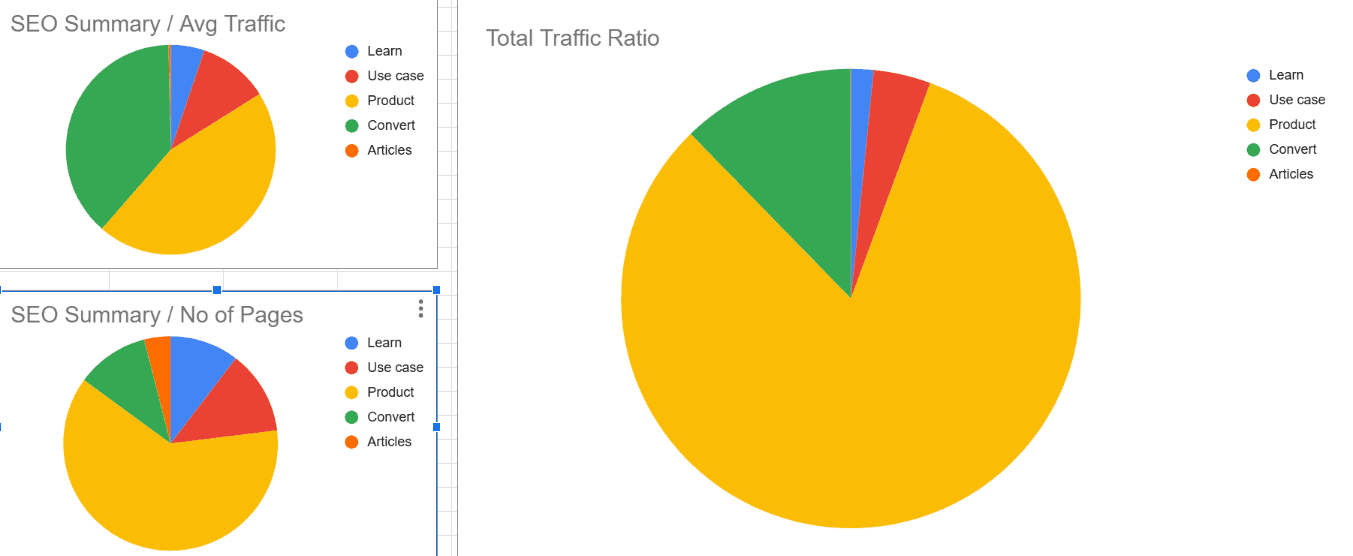
Image alt text: Competitors’ Research Sample from Rank Wizards

Keyword Research

Keyword research is one of the most important tasks of on page SEO, because it clarifies what you’re going to create based on who it is going to target. The process of keyword research goes as follows:

  • ICP Analysis, determining the target audience who you are selling to. 

  • USP (Unique Selling Point) analysis, determining what you are best for.

  • Analysing what keywords the competitors rank for, which gives you an idea of using keywords for yourself.

  • Picking up on topics from customer pain points, like frequently asked questions, or sales call information. 

  • SEO tools that can help in keyword research

  • Clustering the similar or related keywords into a group to form a funnel-based topics. 

Content Calendar

After determining the topics and keywords, it’s time to make a content calendar. Content calendars are a month-by-month roadmap for content creation and publishing. For SaaS content strategy, content calendar works as a guide for consistency and helps you cover all the stages of the customer journey one by one according to the schedule. 

What content calendars include are:

  • Keywords, the focus of the content

  • Guidelines of writing the content for the writers

  • Content topics are divided in the categories of TOFU for awareness, MOFU for consideration, and BOFU for decision making

  • Where the CTAs would fit in, and what CTA would be implemented

Technical SEO

Technical optimization of your websites and content refers to technical SEO. Technical SEO makes sure search engines crawl and find your content, understand it, so that it ranks. For SaaS, as they have multiple landing pages, like product features, case studies, blog or content hubs that need to be findable, technical SEO is very important.   

Several things need to be done for technical SEO. Let’s discuss those. 

Technical SEO Audit

Technical SEO audit finds out whatever is wrong with your website that is holding it back from ranking. Some common things technical SEO audit checks are:

  • Crawling and indexing, checking if google can find your pages

  • Site structure, checking if there is a proper flow in transition between your website pages

  • Page speed, checking if pages load quickly, or it takes too long to load

  • Checking if there are issues in mobile-friendliness 

  • Checking if there are broken links and page errors

  • Internal linking, making sure relevant pages of the website are interlinked and the blogs internally link important pages

URL Structure Fixing

URL is the address of your website. A clean URL lets people know and understand what the website is about right away. Messy URLs are not rankable enough, because search engines, along with the audience, find it difficult to crawl, understand and trust. 

Good URL practices are,

  • Readable, descriptive and definitive URL creating

  • Consistent in style, such as, lowercase, separated with hyphen or slash

  • Avoiding numbers or confusing details, keeping it short and as simple as it is

  • Let the page have only one version, no duplicates

301 Redirection for 404 Pages

When you click on a page, but it gets you nowhere except for the text that says “404 not found”, that means that page is removed and does not exist anymore, even though its link is still there. 

It is a frustrating situation, as it is misleading. Because people click on the link expecting to find something, and 404 pages are disappointing. 

However, 301 redirect fixes the disappointment. 301 is a new page replacing the old unavailable page, with updates and reformations. With this redirect, the website user is made to skip the 404 page, and is redirected to the newly made page with updated content. It is like directly going to page B instead of ever visiting the empty page A. 

Fixing 404 pages with 301 redirects is a part of technical SEO that SaaS SEO websites conduct. This process prevents churn rates as well. 

Site Map Submission

Site map is the roadmap of your website. It shows the way from one webpage to another, clearly guiding the visitor to the important pages of your website. Submitting a site map means handing search engines a clean and specific list of content of your website. 

Site map submission ensures that all your significant webpages are discoverable and crawled by search engines. It makes sure that only what you want to show is shown, you can hide the test pages or deleted pages. It also reduces the risk of valuable pages being ignored. You can add your sitemap using google search console. 

LLM Optimization

LLM optimization, despite being a newer phenomenon, is a significant step of SEO strategy. Let’s say you want to look for the best SaaS company. You would look for them in google, yes. But now is the time when you’d usually go to look for options and best suggestions from LLMs like Chatgpt, Claude or Perplexity. People trust the suggestions that AI chats and LLMs provide. So LLM optimization for SaaS companies makes them more visible to the audience. 

For LLM optimization, you need to ensure some technical steps so that AI bots can access and crawl your content, and show you in the results when someone searches for your niche. The steps are:

  • Robot.txt for AI crawlability

  • Schema markup, to let AI understand and categorize your content

  • General LLM optimization in your content, making it understandable, clear, hierarchical, and well-cited

  • Sitemapping, to let AI explore your website and fetch content and information  

Off Page SEO

Off page optimization for search engines is everything to be done outside the website to make it rank. It starts with other websites talking about you. The more websites give you positive mentions, the better it is for the off page SEO. It grows your reputation on the internet. The technical term for the task of growing this reputation is link building. Let’s discuss link building. 

High Authority Link Building

Link building is the process of getting backlinks for your website. Backlink is a link to your website published in some other website, as a vouch for trust. Backlinks need to come from high authority sites, that are called high authority links.  

Rank Wizards manages the link building for clients through guest posts. Let’s elaborate on what exactly we do in Rank Wizards. I, as a guest post writer, wrote an article for website A. Website A is a high authority website. 

In that article, I included a link to website B. So, now, website B just got a backlink for themselves from website A, which is a high authority link. This task of high authority link building has been conducted by Rank Wizards as a service of SEO strategy for our client website B. 

Analytics and Tracking

Tracking and analytics take care of the situation after the SEO strategies implementation is done. One of the mistakes in the SEO strategy is to not observe the results of the implementation. But analyzing and tracking the results is important as a part of the SEO strategy. 

Only traffic observation is not enough. SEO strategists, especially for SaaS, need to see if the strategies are working in users’ conversion or not. You also need to keep tracking the performances to see which strategy is working, and which is not. 

The metrics you need to analyze and track are:

  • Traffic

  • Keyword ranking

  • User engagement

  • Conversion and sign-ups

  • Customer cycle 

  • Revenue growth

SME Writer Recruitment as A Service
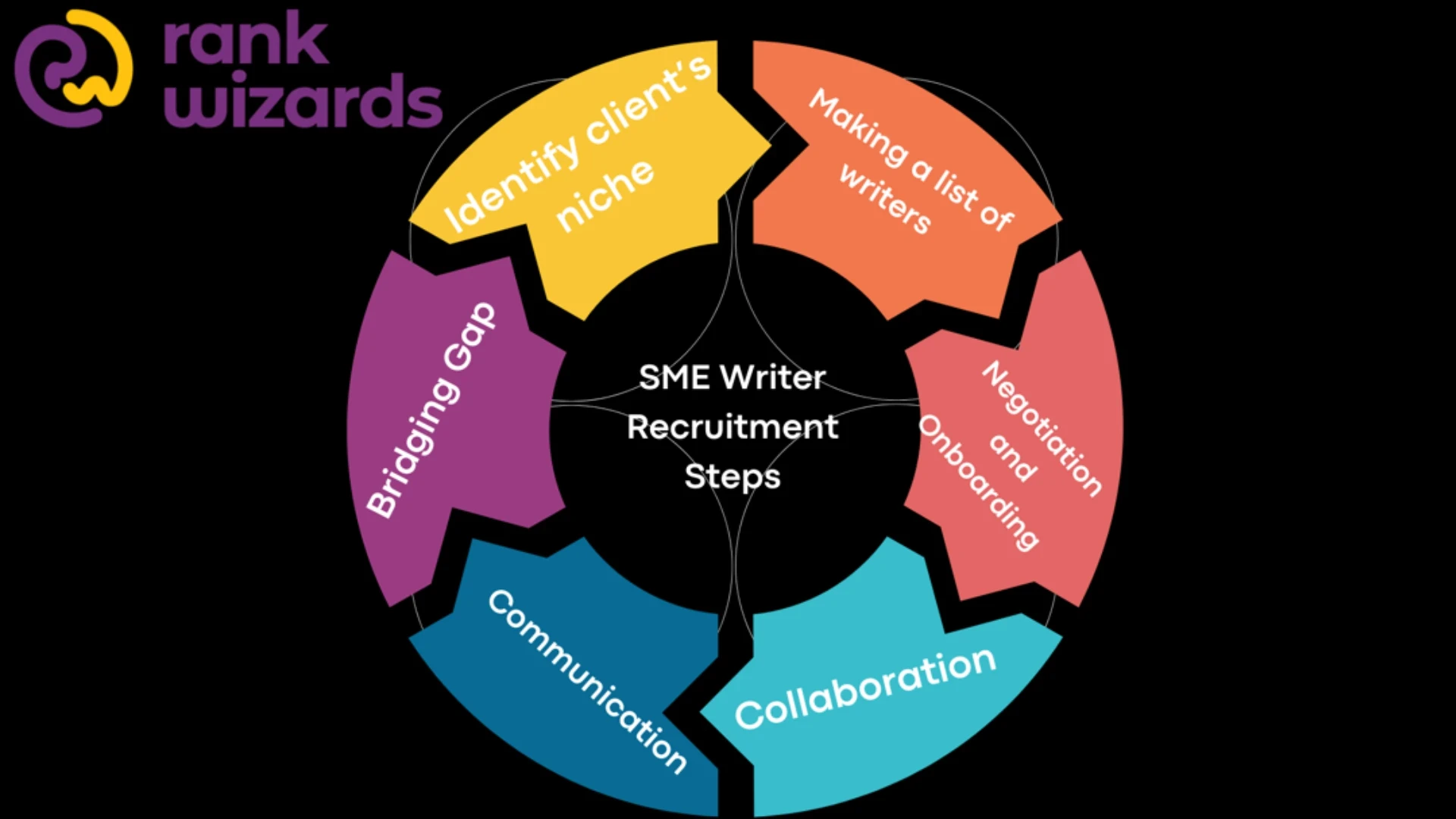
Image alt text: SME Writer Recruitment Steps Visual 

Rank Wizards provides the service of SME writer recruitment. SME writers are subject matter experts, who are found and recruited by Rank Wizards to write content for the clients. This is a well-organized process of collaboration. Let’s look at the procedure of SME writer and client collaboration step by step.

Step 1: Identifying the client’s niche 

Firstly, we identify the clients’ business niche, determining the subject matter and target audience, and understanding the content type. 

Step 2: Making a list of writers

From linkedin pulse or medium, we make a list of niche specific writers and extract industry experts. We send the clients’ brief and a proposal to the extracted writers. The interested writers are assigned with some assessments, and then shortlisted accordingly. 

Step 3: Negotiation and onboarding 

We negotiate payment and work methods with the selected writers to onboard them.

Step 4: Collaboration between the writers and the clients

Now, let’s come to the actual collaboration between the SME writer and the client that is also overseen by Rank Wizards. Firstly, we fully understand the client’s goals and expectations. We distribute the writers across the projects according to their niches. We make sure the SMEs understand their role properly so that the delivery is perfect and properly aimed for the target audience.

Step 5: Establishing a communication pathway 

Content briefs are created and given to the SMEs. Sessions are organized between the SMEs and the clients so that both are on the same page. We establish a clear communication pathway between the clients and SMEs via communication channels like email or Slack. 

Step 6: Establishing further Collaboration; Bridging the Gap 

We also facilitate further collaboration between the two parties. We organize workshops and meetings for SMEs to ask detailed questions to the clients. We manage a way for SMEs and clients to share drafts, revisions, feedbacks and insights with each other to maintain transparency.   

Rank Wizards works as a bridge between the clients and the SMEs.

Here at Rank Wizards, we’ve tested multiple SEO strategies for SaaS. These are the proven strategies that worked which we provide with our SEO services for SaaS from Rank WIzards. Here’s how we do it: 

SEO Quickwins 

Optimization, corrections and results take time for SEO in SaaS. But quickwins can give you quick results. SEO quick wins are some actions that give your website quick and early spike performances like traffic and impression, because they fix some of the issues that can be quickly detected and fixed. 

The main areas that quickwins focus are:

Full Site Audit

Firstly, a complete audit of your SaaS website is made, to identify issues that are holding your website back from ranking. These issues can be:

  • Pages that have broken links

  • Missing meta titles

  • Indexed pages that are not optimized

  • Content gaps

Fixing these issues will give your site an instant boost in traffic/impression.

Easily Rankable Content

There are some low hanging fruits, the easily rankable content that need a little bit of fixing for them to be ready to rank. The issues we can fix are: 

  • Updating backdated information with fresh content and details

  • Updating  the FAQs or any missing sections

  • Fixing the internal linking

  • Updating keyword placing in headings and inside the content 

URL Structure Fixing, Refurbish, and Publish

Often you need to implement some refinements in the content and the website URL to make a difference in the website performance. Such as, you can clean up long or messy URLs and organize them more relevantly. 

On Page SEO for SaaS

On page SEO for SaaS makes sure every webpage of your website is optimized for search engines according to what your users are searching for. With on page optimization, your website becomes easy to navigate for visitors so that they can find what they want. Your relevant webpage also ranks in search engines according to the audience search if it is well optimized. 

On Page Optimization

What things are done for on page optimization: 

  • Optimizing titles and meta descriptions. Title tags let Google know what your content or page is about. Meta descriptions describe the page briefly. If titles and meta descriptions are proper, Google knows what your content is, so it ranks better. 

  • Headings organize the content in its hierarchy. They help Google understand the sectional structure of your content, helping in ranking.

  • Internal linking, which is to link two related webpages together. In internal linking, you link the content of one page to another at a relevant place. This helps and guides the audience to explore the whole website, bringing in more views. It also signals to google that maximum pages of a website are important. 

  • Strong SEO content exponentially helps you rank, because content like blogs or case studies help the audience get solutions they’re searching for their problems. Your content needs to have ideal keyword distribution, ideal heading structure and title and meta description optimization for people to know if they’re reading the right content. 

  • Finally, put CTAs in the right places that encourage the audience to sign up or convert. Signing up for conversion is the goal. Every webpage should have a CTA that encourages viewers to download something or sign up for a demo. This way, you either enable conversion or at least collect leads. 

Competitor Research

It is important to conduct competitors research to know what is going on the market, what you are missing out on, and what you can pick up on. In competitors research, you bring out the keywords your competitors are ranking for, their SEO and traffic situation, and the gaps that can be taken advantage of. 

At Rank Wizards, we conducted competitor research for one of our clients. As the pictures show, they brought out the SEO summary of the competitors, the average traffic of their webpages, and the traffic ratio in their website. This research gives an idea for the client on what they can do next.   

Image alt text: Competitors’ Research Sample from Rank Wizards

Keyword Research

Keyword research is one of the most important tasks of on page SEO, because it clarifies what you’re going to create based on who it is going to target. The process of keyword research goes as follows:

  • ICP Analysis, determining the target audience who you are selling to. 

  • USP (Unique Selling Point) analysis, determining what you are best for.

  • Analysing what keywords the competitors rank for, which gives you an idea of using keywords for yourself.

  • Picking up on topics from customer pain points, like frequently asked questions, or sales call information. 

  • SEO tools that can help in keyword research

  • Clustering the similar or related keywords into a group to form a funnel-based topics. 

Content Calendar

After determining the topics and keywords, it’s time to make a content calendar. Content calendars are a month-by-month roadmap for content creation and publishing. For SaaS content strategy, content calendar works as a guide for consistency and helps you cover all the stages of the customer journey one by one according to the schedule. 

What content calendars include are:

  • Keywords, the focus of the content

  • Guidelines of writing the content for the writers

  • Content topics are divided in the categories of TOFU for awareness, MOFU for consideration, and BOFU for decision making

  • Where the CTAs would fit in, and what CTA would be implemented

Technical SEO

Technical optimization of your websites and content refers to technical SEO. Technical SEO makes sure search engines crawl and find your content, understand it, so that it ranks. For SaaS, as they have multiple landing pages, like product features, case studies, blog or content hubs that need to be findable, technical SEO is very important.   

Several things need to be done for technical SEO. Let’s discuss those. 

Technical SEO Audit

Technical SEO audit finds out whatever is wrong with your website that is holding it back from ranking. Some common things technical SEO audit checks are:

  • Crawling and indexing, checking if google can find your pages

  • Site structure, checking if there is a proper flow in transition between your website pages

  • Page speed, checking if pages load quickly, or it takes too long to load

  • Checking if there are issues in mobile-friendliness 

  • Checking if there are broken links and page errors

  • Internal linking, making sure relevant pages of the website are interlinked and the blogs internally link important pages

URL Structure Fixing

URL is the address of your website. A clean URL lets people know and understand what the website is about right away. Messy URLs are not rankable enough, because search engines, along with the audience, find it difficult to crawl, understand and trust. 

Good URL practices are,

  • Readable, descriptive and definitive URL creating

  • Consistent in style, such as, lowercase, separated with hyphen or slash

  • Avoiding numbers or confusing details, keeping it short and as simple as it is

  • Let the page have only one version, no duplicates

301 Redirection for 404 Pages

When you click on a page, but it gets you nowhere except for the text that says “404 not found”, that means that page is removed and does not exist anymore, even though its link is still there. 

It is a frustrating situation, as it is misleading. Because people click on the link expecting to find something, and 404 pages are disappointing. 

However, 301 redirect fixes the disappointment. 301 is a new page replacing the old unavailable page, with updates and reformations. With this redirect, the website user is made to skip the 404 page, and is redirected to the newly made page with updated content. It is like directly going to page B instead of ever visiting the empty page A. 

Fixing 404 pages with 301 redirects is a part of technical SEO that SaaS SEO websites conduct. This process prevents churn rates as well. 

Site Map Submission

Site map is the roadmap of your website. It shows the way from one webpage to another, clearly guiding the visitor to the important pages of your website. Submitting a site map means handing search engines a clean and specific list of content of your website. 

Site map submission ensures that all your significant webpages are discoverable and crawled by search engines. It makes sure that only what you want to show is shown, you can hide the test pages or deleted pages. It also reduces the risk of valuable pages being ignored. You can add your sitemap using google search console. 

LLM Optimization

LLM optimization, despite being a newer phenomenon, is a significant step of SEO strategy. Let’s say you want to look for the best SaaS company. You would look for them in google, yes. But now is the time when you’d usually go to look for options and best suggestions from LLMs like Chatgpt, Claude or Perplexity. People trust the suggestions that AI chats and LLMs provide. So LLM optimization for SaaS companies makes them more visible to the audience. 

For LLM optimization, you need to ensure some technical steps so that AI bots can access and crawl your content, and show you in the results when someone searches for your niche. The steps are:

  • Robot.txt for AI crawlability

  • Schema markup, to let AI understand and categorize your content

  • General LLM optimization in your content, making it understandable, clear, hierarchical, and well-cited

  • Sitemapping, to let AI explore your website and fetch content and information  

Off Page SEO

Off page optimization for search engines is everything to be done outside the website to make it rank. It starts with other websites talking about you. The more websites give you positive mentions, the better it is for the off page SEO. It grows your reputation on the internet. The technical term for the task of growing this reputation is link building. Let’s discuss link building. 

High Authority Link Building

Link building is the process of getting backlinks for your website. Backlink is a link to your website published in some other website, as a vouch for trust. Backlinks need to come from high authority sites, that are called high authority links.  

Rank Wizards manages the link building for clients through guest posts. Let’s elaborate on what exactly we do in Rank Wizards. I, as a guest post writer, wrote an article for website A. Website A is a high authority website. 

In that article, I included a link to website B. So, now, website B just got a backlink for themselves from website A, which is a high authority link. This task of high authority link building has been conducted by Rank Wizards as a service of SEO strategy for our client website B. 

Analytics and Tracking

Tracking and analytics take care of the situation after the SEO strategies implementation is done. One of the mistakes in the SEO strategy is to not observe the results of the implementation. But analyzing and tracking the results is important as a part of the SEO strategy. 

Only traffic observation is not enough. SEO strategists, especially for SaaS, need to see if the strategies are working in users’ conversion or not. You also need to keep tracking the performances to see which strategy is working, and which is not. 

The metrics you need to analyze and track are:

  • Traffic

  • Keyword ranking

  • User engagement

  • Conversion and sign-ups

  • Customer cycle 

  • Revenue growth

SME Writer Recruitment as A Service

Image alt text: SME Writer Recruitment Steps Visual 

Rank Wizards provides the service of SME writer recruitment. SME writers are subject matter experts, who are found and recruited by Rank Wizards to write content for the clients. This is a well-organized process of collaboration. Let’s look at the procedure of SME writer and client collaboration step by step.

Step 1: Identifying the client’s niche 

Firstly, we identify the clients’ business niche, determining the subject matter and target audience, and understanding the content type. 

Step 2: Making a list of writers

From linkedin pulse or medium, we make a list of niche specific writers and extract industry experts. We send the clients’ brief and a proposal to the extracted writers. The interested writers are assigned with some assessments, and then shortlisted accordingly. 

Step 3: Negotiation and onboarding 

We negotiate payment and work methods with the selected writers to onboard them.

Step 4: Collaboration between the writers and the clients

Now, let’s come to the actual collaboration between the SME writer and the client that is also overseen by Rank Wizards. Firstly, we fully understand the client’s goals and expectations. We distribute the writers across the projects according to their niches. We make sure the SMEs understand their role properly so that the delivery is perfect and properly aimed for the target audience.

Step 5: Establishing a communication pathway 

Content briefs are created and given to the SMEs. Sessions are organized between the SMEs and the clients so that both are on the same page. We establish a clear communication pathway between the clients and SMEs via communication channels like email or Slack. 

Step 6: Establishing further Collaboration; Bridging the Gap 

We also facilitate further collaboration between the two parties. We organize workshops and meetings for SMEs to ask detailed questions to the clients. We manage a way for SMEs and clients to share drafts, revisions, feedbacks and insights with each other to maintain transparency.   

Rank Wizards works as a bridge between the clients and the SMEs.

Here at Rank Wizards, we’ve tested multiple SEO strategies for SaaS. These are the proven strategies that worked which we provide with our SEO services for SaaS from Rank WIzards. Here’s how we do it: 

SEO Quickwins 

Optimization, corrections and results take time for SEO in SaaS. But quickwins can give you quick results. SEO quick wins are some actions that give your website quick and early spike performances like traffic and impression, because they fix some of the issues that can be quickly detected and fixed. 

The main areas that quickwins focus are:

Full Site Audit

Firstly, a complete audit of your SaaS website is made, to identify issues that are holding your website back from ranking. These issues can be:

  • Pages that have broken links

  • Missing meta titles

  • Indexed pages that are not optimized

  • Content gaps

Fixing these issues will give your site an instant boost in traffic/impression.

Easily Rankable Content

There are some low hanging fruits, the easily rankable content that need a little bit of fixing for them to be ready to rank. The issues we can fix are: 

  • Updating backdated information with fresh content and details

  • Updating  the FAQs or any missing sections

  • Fixing the internal linking

  • Updating keyword placing in headings and inside the content 

URL Structure Fixing, Refurbish, and Publish

Often you need to implement some refinements in the content and the website URL to make a difference in the website performance. Such as, you can clean up long or messy URLs and organize them more relevantly. 

On Page SEO for SaaS

On page SEO for SaaS makes sure every webpage of your website is optimized for search engines according to what your users are searching for. With on page optimization, your website becomes easy to navigate for visitors so that they can find what they want. Your relevant webpage also ranks in search engines according to the audience search if it is well optimized. 

On Page Optimization

What things are done for on page optimization: 

  • Optimizing titles and meta descriptions. Title tags let Google know what your content or page is about. Meta descriptions describe the page briefly. If titles and meta descriptions are proper, Google knows what your content is, so it ranks better. 

  • Headings organize the content in its hierarchy. They help Google understand the sectional structure of your content, helping in ranking.

  • Internal linking, which is to link two related webpages together. In internal linking, you link the content of one page to another at a relevant place. This helps and guides the audience to explore the whole website, bringing in more views. It also signals to google that maximum pages of a website are important. 

  • Strong SEO content exponentially helps you rank, because content like blogs or case studies help the audience get solutions they’re searching for their problems. Your content needs to have ideal keyword distribution, ideal heading structure and title and meta description optimization for people to know if they’re reading the right content. 

  • Finally, put CTAs in the right places that encourage the audience to sign up or convert. Signing up for conversion is the goal. Every webpage should have a CTA that encourages viewers to download something or sign up for a demo. This way, you either enable conversion or at least collect leads. 

Competitor Research

It is important to conduct competitors research to know what is going on the market, what you are missing out on, and what you can pick up on. In competitors research, you bring out the keywords your competitors are ranking for, their SEO and traffic situation, and the gaps that can be taken advantage of. 

At Rank Wizards, we conducted competitor research for one of our clients. As the pictures show, they brought out the SEO summary of the competitors, the average traffic of their webpages, and the traffic ratio in their website. This research gives an idea for the client on what they can do next.   

Image alt text: Competitors’ Research Sample from Rank Wizards

Keyword Research

Keyword research is one of the most important tasks of on page SEO, because it clarifies what you’re going to create based on who it is going to target. The process of keyword research goes as follows:

  • ICP Analysis, determining the target audience who you are selling to. 

  • USP (Unique Selling Point) analysis, determining what you are best for.

  • Analysing what keywords the competitors rank for, which gives you an idea of using keywords for yourself.

  • Picking up on topics from customer pain points, like frequently asked questions, or sales call information. 

  • SEO tools that can help in keyword research

  • Clustering the similar or related keywords into a group to form a funnel-based topics. 

Content Calendar

After determining the topics and keywords, it’s time to make a content calendar. Content calendars are a month-by-month roadmap for content creation and publishing. For SaaS content strategy, content calendar works as a guide for consistency and helps you cover all the stages of the customer journey one by one according to the schedule. 

What content calendars include are:

  • Keywords, the focus of the content

  • Guidelines of writing the content for the writers

  • Content topics are divided in the categories of TOFU for awareness, MOFU for consideration, and BOFU for decision making

  • Where the CTAs would fit in, and what CTA would be implemented

Technical SEO

Technical optimization of your websites and content refers to technical SEO. Technical SEO makes sure search engines crawl and find your content, understand it, so that it ranks. For SaaS, as they have multiple landing pages, like product features, case studies, blog or content hubs that need to be findable, technical SEO is very important.   

Several things need to be done for technical SEO. Let’s discuss those. 

Technical SEO Audit

Technical SEO audit finds out whatever is wrong with your website that is holding it back from ranking. Some common things technical SEO audit checks are:

  • Crawling and indexing, checking if google can find your pages

  • Site structure, checking if there is a proper flow in transition between your website pages

  • Page speed, checking if pages load quickly, or it takes too long to load

  • Checking if there are issues in mobile-friendliness 

  • Checking if there are broken links and page errors

  • Internal linking, making sure relevant pages of the website are interlinked and the blogs internally link important pages

URL Structure Fixing

URL is the address of your website. A clean URL lets people know and understand what the website is about right away. Messy URLs are not rankable enough, because search engines, along with the audience, find it difficult to crawl, understand and trust. 

Good URL practices are,

  • Readable, descriptive and definitive URL creating

  • Consistent in style, such as, lowercase, separated with hyphen or slash

  • Avoiding numbers or confusing details, keeping it short and as simple as it is

  • Let the page have only one version, no duplicates

301 Redirection for 404 Pages

When you click on a page, but it gets you nowhere except for the text that says “404 not found”, that means that page is removed and does not exist anymore, even though its link is still there. 

It is a frustrating situation, as it is misleading. Because people click on the link expecting to find something, and 404 pages are disappointing. 

However, 301 redirect fixes the disappointment. 301 is a new page replacing the old unavailable page, with updates and reformations. With this redirect, the website user is made to skip the 404 page, and is redirected to the newly made page with updated content. It is like directly going to page B instead of ever visiting the empty page A. 

Fixing 404 pages with 301 redirects is a part of technical SEO that SaaS SEO websites conduct. This process prevents churn rates as well. 

Site Map Submission

Site map is the roadmap of your website. It shows the way from one webpage to another, clearly guiding the visitor to the important pages of your website. Submitting a site map means handing search engines a clean and specific list of content of your website. 

Site map submission ensures that all your significant webpages are discoverable and crawled by search engines. It makes sure that only what you want to show is shown, you can hide the test pages or deleted pages. It also reduces the risk of valuable pages being ignored. You can add your sitemap using google search console. 

LLM Optimization

LLM optimization, despite being a newer phenomenon, is a significant step of SEO strategy. Let’s say you want to look for the best SaaS company. You would look for them in google, yes. But now is the time when you’d usually go to look for options and best suggestions from LLMs like Chatgpt, Claude or Perplexity. People trust the suggestions that AI chats and LLMs provide. So LLM optimization for SaaS companies makes them more visible to the audience. 

For LLM optimization, you need to ensure some technical steps so that AI bots can access and crawl your content, and show you in the results when someone searches for your niche. The steps are:

  • Robot.txt for AI crawlability

  • Schema markup, to let AI understand and categorize your content

  • General LLM optimization in your content, making it understandable, clear, hierarchical, and well-cited

  • Sitemapping, to let AI explore your website and fetch content and information  

Off Page SEO

Off page optimization for search engines is everything to be done outside the website to make it rank. It starts with other websites talking about you. The more websites give you positive mentions, the better it is for the off page SEO. It grows your reputation on the internet. The technical term for the task of growing this reputation is link building. Let’s discuss link building. 

High Authority Link Building

Link building is the process of getting backlinks for your website. Backlink is a link to your website published in some other website, as a vouch for trust. Backlinks need to come from high authority sites, that are called high authority links.  

Rank Wizards manages the link building for clients through guest posts. Let’s elaborate on what exactly we do in Rank Wizards. I, as a guest post writer, wrote an article for website A. Website A is a high authority website. 

In that article, I included a link to website B. So, now, website B just got a backlink for themselves from website A, which is a high authority link. This task of high authority link building has been conducted by Rank Wizards as a service of SEO strategy for our client website B. 

Analytics and Tracking

Tracking and analytics take care of the situation after the SEO strategies implementation is done. One of the mistakes in the SEO strategy is to not observe the results of the implementation. But analyzing and tracking the results is important as a part of the SEO strategy. 

Only traffic observation is not enough. SEO strategists, especially for SaaS, need to see if the strategies are working in users’ conversion or not. You also need to keep tracking the performances to see which strategy is working, and which is not. 

The metrics you need to analyze and track are:

  • Traffic

  • Keyword ranking

  • User engagement

  • Conversion and sign-ups

  • Customer cycle 

  • Revenue growth

SME Writer Recruitment as A Service

Image alt text: SME Writer Recruitment Steps Visual 

Rank Wizards provides the service of SME writer recruitment. SME writers are subject matter experts, who are found and recruited by Rank Wizards to write content for the clients. This is a well-organized process of collaboration. Let’s look at the procedure of SME writer and client collaboration step by step.

Step 1: Identifying the client’s niche 

Firstly, we identify the clients’ business niche, determining the subject matter and target audience, and understanding the content type. 

Step 2: Making a list of writers

From linkedin pulse or medium, we make a list of niche specific writers and extract industry experts. We send the clients’ brief and a proposal to the extracted writers. The interested writers are assigned with some assessments, and then shortlisted accordingly. 

Step 3: Negotiation and onboarding 

We negotiate payment and work methods with the selected writers to onboard them.

Step 4: Collaboration between the writers and the clients

Now, let’s come to the actual collaboration between the SME writer and the client that is also overseen by Rank Wizards. Firstly, we fully understand the client’s goals and expectations. We distribute the writers across the projects according to their niches. We make sure the SMEs understand their role properly so that the delivery is perfect and properly aimed for the target audience.

Step 5: Establishing a communication pathway 

Content briefs are created and given to the SMEs. Sessions are organized between the SMEs and the clients so that both are on the same page. We establish a clear communication pathway between the clients and SMEs via communication channels like email or Slack. 

Step 6: Establishing further Collaboration; Bridging the Gap 

We also facilitate further collaboration between the two parties. We organize workshops and meetings for SMEs to ask detailed questions to the clients. We manage a way for SMEs and clients to share drafts, revisions, feedbacks and insights with each other to maintain transparency.   

Rank Wizards works as a bridge between the clients and the SMEs.

Closing Remarks

SEO for SaaS is as essential as marketing is for any business. You need to let people know that you exist, and SEO ensures that. People search for what they need, SEO makes sure your SaaS shows up in the search results of their needs and solutions to their problems. Not only visibility, SEO influences users’ conversion as well. 

You can rely on Rank Wizards for strong SEO strategies for SaaS. Most of the strategies that we’ve discussed here in this blog are confidently covered by Rank Wizards. You can also go for Rank Wizards for a holistic and expert SEO consulting service.

SEO for SaaS is as essential as marketing is for any business. You need to let people know that you exist, and SEO ensures that. People search for what they need, SEO makes sure your SaaS shows up in the search results of their needs and solutions to their problems. Not only visibility, SEO influences users’ conversion as well. 

You can rely on Rank Wizards for strong SEO strategies for SaaS. Most of the strategies that we’ve discussed here in this blog are confidently covered by Rank Wizards. You can also go for Rank Wizards for a holistic and expert SEO consulting service.

SEO for SaaS is as essential as marketing is for any business. You need to let people know that you exist, and SEO ensures that. People search for what they need, SEO makes sure your SaaS shows up in the search results of their needs and solutions to their problems. Not only visibility, SEO influences users’ conversion as well. 

You can rely on Rank Wizards for strong SEO strategies for SaaS. Most of the strategies that we’ve discussed here in this blog are confidently covered by Rank Wizards. You can also go for Rank Wizards for a holistic and expert SEO consulting service.

Frequently Asked Question

How to do SEO for SaaS?

  • Keyword list creation

  • Competitor analysis

  • Keyword mapping to buyers journey stages

  • Topic cluster building

  • Identification of opportunities and quickly solvable issues

  • Gap analysis

  • Implementation of strategies

What are the four types of SEO

The interconnected four types of SEO are, on-page, off-page, technical and local SEO. 

What is B2B SaaS SEO?

B2B SaaS SEO is the process of optimization of a Software-as-a-Service website from top to bottom in order to gain organic traffic, visitors, and users or customers for the business. The goal is to drive more conversion. 

What are 3 C’s of SEO

The 3 C’s for SEO are: Condent, Code and Credibility.

How to do SEO for SaaS?

  • Keyword list creation

  • Competitor analysis

  • Keyword mapping to buyers journey stages

  • Topic cluster building

  • Identification of opportunities and quickly solvable issues

  • Gap analysis

  • Implementation of strategies

What are the four types of SEO

The interconnected four types of SEO are, on-page, off-page, technical and local SEO. 

What is B2B SaaS SEO?

B2B SaaS SEO is the process of optimization of a Software-as-a-Service website from top to bottom in order to gain organic traffic, visitors, and users or customers for the business. The goal is to drive more conversion. 

What are 3 C’s of SEO

The 3 C’s for SEO are: Condent, Code and Credibility.

How to do SEO for SaaS?

  • Keyword list creation

  • Competitor analysis

  • Keyword mapping to buyers journey stages

  • Topic cluster building

  • Identification of opportunities and quickly solvable issues

  • Gap analysis

  • Implementation of strategies

What are the four types of SEO

The interconnected four types of SEO are, on-page, off-page, technical and local SEO. 

What is B2B SaaS SEO?

B2B SaaS SEO is the process of optimization of a Software-as-a-Service website from top to bottom in order to gain organic traffic, visitors, and users or customers for the business. The goal is to drive more conversion. 

What are 3 C’s of SEO

The 3 C’s for SEO are: Condent, Code and Credibility.

Noshin
Noshin
Noshin

Noshin Nisa

Noshin Nisa

Noshin Nisa

Content Writer

Content Writer

I make sure readers get to know what I can help them know through my words and understanding.

I make sure readers get to know what I can help them know through my words and understanding.

I make sure readers get to know what I can help them know through my words and understanding.

Get a Free SEO Growth Plan

Get a Free SEO Growth Plan

Get a Free SEO Growth Plan

Share on social media

Share on social media

Share on social media

, '
SaaS SEO strategy

SEO Strategy for SaaS

SaaS SEO strategy

SEO Strategy for SaaS

SaaS SEO strategy

SEO Strategy for SaaS

Summarize with AI

Sep 15, 2025

2 min read

TL;DR

Did you know that according to a recent study, 92% of SaaS startups fail within 3 years of launch? Your SaaS company is one of the many SaaS companies out there trying to survive in the market with the competition of visibility. Not only this, 73% of SaaS startups fail to hit their first $1M ARR over its lifespan. Yes, the struggle is real. You can’t always rely on paid ads or superficial promotional methods for genuine visibility. To gain eyeballs from niche specific relevant audiences, your strategy needs to be strong and genuine also. For that you need to implement search engine optimization for getting interaction from genuine and relevant people. Unlike the paid ad strategy, SEO strategy in SaaS sustains. SEO in SaaS is not just chasing traffic like traditional SEO. For SaaS, SEO is about gaining market qualified leads (MQL), the leads that will possibly convert and sign up. This blog will be discussing proven and workable strategies of SEO for SaaS, and how we as a SaaS SEO agency implement those strategies.

What is SaaS SEO?

For SaaS SEO, you optimize your website, online content and overall online presence to rank in Google search engine, so that the right audience finds you against the relevant keywords. 

However, SEO for SaaS is much deeper than simply ranking with keywords. 

The things SaaS SEO works on are:

  • ICP (Ideal Customer Profile) making, for targeting the exact type of traffic who will eventually convert.

  • Creating or guiding to create educational top of the funnel content, solution based middle of the funnel content, and demo and transaction driven bottom of the funnel content, all with the intention to lead the acquired traffic towards conversion. 

  • Keeping the product feature page, case study page, content page etc optimized for easy discovery on Google.

  • Maintaining continuity. This process aims to keep bringing up sign-ups, conversions and demos by making sure that your company website shows up where the customers and searchers need it. 

  • Helps you reduce cost per acquisition in contrary of PPC or other social media paid ads

For SaaS SEO, you optimize your website, online content and overall online presence to rank in Google search engine, so that the right audience finds you against the relevant keywords. 

However, SEO for SaaS is much deeper than simply ranking with keywords. 

The things SaaS SEO works on are:

  • ICP (Ideal Customer Profile) making, for targeting the exact type of traffic who will eventually convert.

  • Creating or guiding to create educational top of the funnel content, solution based middle of the funnel content, and demo and transaction driven bottom of the funnel content, all with the intention to lead the acquired traffic towards conversion. 

  • Keeping the product feature page, case study page, content page etc optimized for easy discovery on Google.

  • Maintaining continuity. This process aims to keep bringing up sign-ups, conversions and demos by making sure that your company website shows up where the customers and searchers need it. 

  • Helps you reduce cost per acquisition in contrary of PPC or other social media paid ads

For SaaS SEO, you optimize your website, online content and overall online presence to rank in Google search engine, so that the right audience finds you against the relevant keywords. 

However, SEO for SaaS is much deeper than simply ranking with keywords. 

The things SaaS SEO works on are:

  • ICP (Ideal Customer Profile) making, for targeting the exact type of traffic who will eventually convert.

  • Creating or guiding to create educational top of the funnel content, solution based middle of the funnel content, and demo and transaction driven bottom of the funnel content, all with the intention to lead the acquired traffic towards conversion. 

  • Keeping the product feature page, case study page, content page etc optimized for easy discovery on Google.

  • Maintaining continuity. This process aims to keep bringing up sign-ups, conversions and demos by making sure that your company website shows up where the customers and searchers need it. 

  • Helps you reduce cost per acquisition in contrary of PPC or other social media paid ads

The Importance of SEO in SaaS

SEO is reliable for SaaS in bringing in customers. 

SEO increases the chances of your website or company getting reached to people who need your service. It helps people find you when they are looking for solutions or comparing websites. Better SEO increases your possibility to get chosen as well. 

Let’s see how:

  • SEO reduces the customer acquisition cost (CPA). In contrast to paid ads that cost more with increasing competition, SEO reduces the expense, because as you rank, you gain more leads without having to pay for ads. 

  • SaaS buyers don’t convert easily. They have to study and research about your SaaS for them to decide what they pick. Search engine optimized content and website educate your audience to make their research easier, making it possible for you to get chosen.

  • SaaS SEO plays a massive role in omni-channel marketing by building brand awareness and topical authority. 

SEO is reliable for SaaS in bringing in customers. 

SEO increases the chances of your website or company getting reached to people who need your service. It helps people find you when they are looking for solutions or comparing websites. Better SEO increases your possibility to get chosen as well. 

Let’s see how:

  • SEO reduces the customer acquisition cost (CPA). In contrast to paid ads that cost more with increasing competition, SEO reduces the expense, because as you rank, you gain more leads without having to pay for ads. 

  • SaaS buyers don’t convert easily. They have to study and research about your SaaS for them to decide what they pick. Search engine optimized content and website educate your audience to make their research easier, making it possible for you to get chosen.

  • SaaS SEO plays a massive role in omni-channel marketing by building brand awareness and topical authority. 

SEO is reliable for SaaS in bringing in customers. 

SEO increases the chances of your website or company getting reached to people who need your service. It helps people find you when they are looking for solutions or comparing websites. Better SEO increases your possibility to get chosen as well. 

Let’s see how:

  • SEO reduces the customer acquisition cost (CPA). In contrast to paid ads that cost more with increasing competition, SEO reduces the expense, because as you rank, you gain more leads without having to pay for ads. 

  • SaaS buyers don’t convert easily. They have to study and research about your SaaS for them to decide what they pick. Search engine optimized content and website educate your audience to make their research easier, making it possible for you to get chosen.

  • SaaS SEO plays a massive role in omni-channel marketing by building brand awareness and topical authority. 

SaaS SEO vs Traditional SEO: The Difference and Comparison

Though SEO seems the same for every business, SaaS SEO is different from traditional SEO in terms of intent and performance. Let’s discuss the difference. 

  • The research method for SaaS SEO and traditional SEO varies. Traditionally, research is done on high volume keywords that are also generic. For SaaS, intent matters more than volume, having to do research with high-intent keywords.

  • For funnel positioning, traditional SEO prioritizes top of the funnel target. But SaaS SEO aims for the full funnel, ultimately focusing on conversion and retention.

  • Traditionally, SEO prioritizes website traffic, ranking and bounce rates. SaaS SEO remains practical, prioritizing signups, transactions and churn rates. 

  • Traditional SEO maps content based on keywords only. But for SaaS, content mapping varies in terms of funnel stages, personas and product features. 

Traditional SEO assumes a linear and straightforward path for the buyer’s journey. For SaaS, the buyer’s journey is complicated, requiring multiple decision making steps in between.

Though SEO seems the same for every business, SaaS SEO is different from traditional SEO in terms of intent and performance. Let’s discuss the difference. 

  • The research method for SaaS SEO and traditional SEO varies. Traditionally, research is done on high volume keywords that are also generic. For SaaS, intent matters more than volume, having to do research with high-intent keywords.

  • For funnel positioning, traditional SEO prioritizes top of the funnel target. But SaaS SEO aims for the full funnel, ultimately focusing on conversion and retention.

  • Traditionally, SEO prioritizes website traffic, ranking and bounce rates. SaaS SEO remains practical, prioritizing signups, transactions and churn rates. 

  • Traditional SEO maps content based on keywords only. But for SaaS, content mapping varies in terms of funnel stages, personas and product features. 

Traditional SEO assumes a linear and straightforward path for the buyer’s journey. For SaaS, the buyer’s journey is complicated, requiring multiple decision making steps in between.

Though SEO seems the same for every business, SaaS SEO is different from traditional SEO in terms of intent and performance. Let’s discuss the difference. 

  • The research method for SaaS SEO and traditional SEO varies. Traditionally, research is done on high volume keywords that are also generic. For SaaS, intent matters more than volume, having to do research with high-intent keywords.

  • For funnel positioning, traditional SEO prioritizes top of the funnel target. But SaaS SEO aims for the full funnel, ultimately focusing on conversion and retention.

  • Traditionally, SEO prioritizes website traffic, ranking and bounce rates. SaaS SEO remains practical, prioritizing signups, transactions and churn rates. 

  • Traditional SEO maps content based on keywords only. But for SaaS, content mapping varies in terms of funnel stages, personas and product features. 

Traditional SEO assumes a linear and straightforward path for the buyer’s journey. For SaaS, the buyer’s journey is complicated, requiring multiple decision making steps in between.

The Best Proven SEO Strategies for SaaS

Here at Rank Wizards, we’ve tested multiple SEO strategies for SaaS. These are the proven strategies that worked which we provide with our SEO services for SaaS from Rank WIzards. Here’s how we do it: 

SEO Quickwins 

Optimization, corrections and results take time for SEO in SaaS. But quickwins can give you quick results. SEO quick wins are some actions that give your website quick and early spike performances like traffic and impression, because they fix some of the issues that can be quickly detected and fixed. 

The main areas that quickwins focus are:

Full Site Audit

Firstly, a complete audit of your SaaS website is made, to identify issues that are holding your website back from ranking. These issues can be:

  • Pages that have broken links

  • Missing meta titles

  • Indexed pages that are not optimized

  • Content gaps

Fixing these issues will give your site an instant boost in traffic/impression.

Easily Rankable Content

There are some low hanging fruits, the easily rankable content that need a little bit of fixing for them to be ready to rank. The issues we can fix are: 

  • Updating backdated information with fresh content and details

  • Updating  the FAQs or any missing sections

  • Fixing the internal linking

  • Updating keyword placing in headings and inside the content 

URL Structure Fixing, Refurbish, and Publish

Often you need to implement some refinements in the content and the website URL to make a difference in the website performance. Such as, you can clean up long or messy URLs and organize them more relevantly. 

On Page SEO for SaaS

On page SEO for SaaS makes sure every webpage of your website is optimized for search engines according to what your users are searching for. With on page optimization, your website becomes easy to navigate for visitors so that they can find what they want. Your relevant webpage also ranks in search engines according to the audience search if it is well optimized. 

On Page Optimization

What things are done for on page optimization: 

  • Optimizing titles and meta descriptions. Title tags let Google know what your content or page is about. Meta descriptions describe the page briefly. If titles and meta descriptions are proper, Google knows what your content is, so it ranks better. 

  • Headings organize the content in its hierarchy. They help Google understand the sectional structure of your content, helping in ranking.

  • Internal linking, which is to link two related webpages together. In internal linking, you link the content of one page to another at a relevant place. This helps and guides the audience to explore the whole website, bringing in more views. It also signals to google that maximum pages of a website are important. 

  • Strong SEO content exponentially helps you rank, because content like blogs or case studies help the audience get solutions they’re searching for their problems. Your content needs to have ideal keyword distribution, ideal heading structure and title and meta description optimization for people to know if they’re reading the right content. 

  • Finally, put CTAs in the right places that encourage the audience to sign up or convert. Signing up for conversion is the goal. Every webpage should have a CTA that encourages viewers to download something or sign up for a demo. This way, you either enable conversion or at least collect leads. 

Competitor Research

It is important to conduct competitors research to know what is going on the market, what you are missing out on, and what you can pick up on. In competitors research, you bring out the keywords your competitors are ranking for, their SEO and traffic situation, and the gaps that can be taken advantage of. 

At Rank Wizards, we conducted competitor research for one of our clients. As the pictures show, they brought out the SEO summary of the competitors, the average traffic of their webpages, and the traffic ratio in their website. This research gives an idea for the client on what they can do next.   

Image alt text: Competitors’ Research Sample from Rank Wizards

Keyword Research

Keyword research is one of the most important tasks of on page SEO, because it clarifies what you’re going to create based on who it is going to target. The process of keyword research goes as follows:

  • ICP Analysis, determining the target audience who you are selling to. 

  • USP (Unique Selling Point) analysis, determining what you are best for.

  • Analysing what keywords the competitors rank for, which gives you an idea of using keywords for yourself.

  • Picking up on topics from customer pain points, like frequently asked questions, or sales call information. 

  • SEO tools that can help in keyword research

  • Clustering the similar or related keywords into a group to form a funnel-based topics. 

Content Calendar

After determining the topics and keywords, it’s time to make a content calendar. Content calendars are a month-by-month roadmap for content creation and publishing. For SaaS content strategy, content calendar works as a guide for consistency and helps you cover all the stages of the customer journey one by one according to the schedule. 

What content calendars include are:

  • Keywords, the focus of the content

  • Guidelines of writing the content for the writers

  • Content topics are divided in the categories of TOFU for awareness, MOFU for consideration, and BOFU for decision making

  • Where the CTAs would fit in, and what CTA would be implemented

Technical SEO

Technical optimization of your websites and content refers to technical SEO. Technical SEO makes sure search engines crawl and find your content, understand it, so that it ranks. For SaaS, as they have multiple landing pages, like product features, case studies, blog or content hubs that need to be findable, technical SEO is very important.   

Several things need to be done for technical SEO. Let’s discuss those. 

Technical SEO Audit

Technical SEO audit finds out whatever is wrong with your website that is holding it back from ranking. Some common things technical SEO audit checks are:

  • Crawling and indexing, checking if google can find your pages

  • Site structure, checking if there is a proper flow in transition between your website pages

  • Page speed, checking if pages load quickly, or it takes too long to load

  • Checking if there are issues in mobile-friendliness 

  • Checking if there are broken links and page errors

  • Internal linking, making sure relevant pages of the website are interlinked and the blogs internally link important pages

URL Structure Fixing

URL is the address of your website. A clean URL lets people know and understand what the website is about right away. Messy URLs are not rankable enough, because search engines, along with the audience, find it difficult to crawl, understand and trust. 

Good URL practices are,

  • Readable, descriptive and definitive URL creating

  • Consistent in style, such as, lowercase, separated with hyphen or slash

  • Avoiding numbers or confusing details, keeping it short and as simple as it is

  • Let the page have only one version, no duplicates

301 Redirection for 404 Pages

When you click on a page, but it gets you nowhere except for the text that says “404 not found”, that means that page is removed and does not exist anymore, even though its link is still there. 

It is a frustrating situation, as it is misleading. Because people click on the link expecting to find something, and 404 pages are disappointing. 

However, 301 redirect fixes the disappointment. 301 is a new page replacing the old unavailable page, with updates and reformations. With this redirect, the website user is made to skip the 404 page, and is redirected to the newly made page with updated content. It is like directly going to page B instead of ever visiting the empty page A. 

Fixing 404 pages with 301 redirects is a part of technical SEO that SaaS SEO websites conduct. This process prevents churn rates as well. 

Site Map Submission

Site map is the roadmap of your website. It shows the way from one webpage to another, clearly guiding the visitor to the important pages of your website. Submitting a site map means handing search engines a clean and specific list of content of your website. 

Site map submission ensures that all your significant webpages are discoverable and crawled by search engines. It makes sure that only what you want to show is shown, you can hide the test pages or deleted pages. It also reduces the risk of valuable pages being ignored. You can add your sitemap using google search console. 

LLM Optimization

LLM optimization, despite being a newer phenomenon, is a significant step of SEO strategy. Let’s say you want to look for the best SaaS company. You would look for them in google, yes. But now is the time when you’d usually go to look for options and best suggestions from LLMs like Chatgpt, Claude or Perplexity. People trust the suggestions that AI chats and LLMs provide. So LLM optimization for SaaS companies makes them more visible to the audience. 

For LLM optimization, you need to ensure some technical steps so that AI bots can access and crawl your content, and show you in the results when someone searches for your niche. The steps are:

  • Robot.txt for AI crawlability

  • Schema markup, to let AI understand and categorize your content

  • General LLM optimization in your content, making it understandable, clear, hierarchical, and well-cited

  • Sitemapping, to let AI explore your website and fetch content and information  

Off Page SEO

Off page optimization for search engines is everything to be done outside the website to make it rank. It starts with other websites talking about you. The more websites give you positive mentions, the better it is for the off page SEO. It grows your reputation on the internet. The technical term for the task of growing this reputation is link building. Let’s discuss link building. 

High Authority Link Building

Link building is the process of getting backlinks for your website. Backlink is a link to your website published in some other website, as a vouch for trust. Backlinks need to come from high authority sites, that are called high authority links.  

Rank Wizards manages the link building for clients through guest posts. Let’s elaborate on what exactly we do in Rank Wizards. I, as a guest post writer, wrote an article for website A. Website A is a high authority website. 

In that article, I included a link to website B. So, now, website B just got a backlink for themselves from website A, which is a high authority link. This task of high authority link building has been conducted by Rank Wizards as a service of SEO strategy for our client website B. 

Analytics and Tracking

Tracking and analytics take care of the situation after the SEO strategies implementation is done. One of the mistakes in the SEO strategy is to not observe the results of the implementation. But analyzing and tracking the results is important as a part of the SEO strategy. 

Only traffic observation is not enough. SEO strategists, especially for SaaS, need to see if the strategies are working in users’ conversion or not. You also need to keep tracking the performances to see which strategy is working, and which is not. 

The metrics you need to analyze and track are:

  • Traffic

  • Keyword ranking

  • User engagement

  • Conversion and sign-ups

  • Customer cycle 

  • Revenue growth

SME Writer Recruitment as A Service

Image alt text: SME Writer Recruitment Steps Visual 

Rank Wizards provides the service of SME writer recruitment. SME writers are subject matter experts, who are found and recruited by Rank Wizards to write content for the clients. This is a well-organized process of collaboration. Let’s look at the procedure of SME writer and client collaboration step by step.

Step 1: Identifying the client’s niche 

Firstly, we identify the clients’ business niche, determining the subject matter and target audience, and understanding the content type. 

Step 2: Making a list of writers

From linkedin pulse or medium, we make a list of niche specific writers and extract industry experts. We send the clients’ brief and a proposal to the extracted writers. The interested writers are assigned with some assessments, and then shortlisted accordingly. 

Step 3: Negotiation and onboarding 

We negotiate payment and work methods with the selected writers to onboard them.

Step 4: Collaboration between the writers and the clients

Now, let’s come to the actual collaboration between the SME writer and the client that is also overseen by Rank Wizards. Firstly, we fully understand the client’s goals and expectations. We distribute the writers across the projects according to their niches. We make sure the SMEs understand their role properly so that the delivery is perfect and properly aimed for the target audience.

Step 5: Establishing a communication pathway 

Content briefs are created and given to the SMEs. Sessions are organized between the SMEs and the clients so that both are on the same page. We establish a clear communication pathway between the clients and SMEs via communication channels like email or Slack. 

Step 6: Establishing further Collaboration; Bridging the Gap 

We also facilitate further collaboration between the two parties. We organize workshops and meetings for SMEs to ask detailed questions to the clients. We manage a way for SMEs and clients to share drafts, revisions, feedbacks and insights with each other to maintain transparency.   

Rank Wizards works as a bridge between the clients and the SMEs.

Here at Rank Wizards, we’ve tested multiple SEO strategies for SaaS. These are the proven strategies that worked which we provide with our SEO services for SaaS from Rank WIzards. Here’s how we do it: 

SEO Quickwins 

Optimization, corrections and results take time for SEO in SaaS. But quickwins can give you quick results. SEO quick wins are some actions that give your website quick and early spike performances like traffic and impression, because they fix some of the issues that can be quickly detected and fixed. 

The main areas that quickwins focus are:

Full Site Audit

Firstly, a complete audit of your SaaS website is made, to identify issues that are holding your website back from ranking. These issues can be:

  • Pages that have broken links

  • Missing meta titles

  • Indexed pages that are not optimized

  • Content gaps

Fixing these issues will give your site an instant boost in traffic/impression.

Easily Rankable Content

There are some low hanging fruits, the easily rankable content that need a little bit of fixing for them to be ready to rank. The issues we can fix are: 

  • Updating backdated information with fresh content and details

  • Updating  the FAQs or any missing sections

  • Fixing the internal linking

  • Updating keyword placing in headings and inside the content 

URL Structure Fixing, Refurbish, and Publish

Often you need to implement some refinements in the content and the website URL to make a difference in the website performance. Such as, you can clean up long or messy URLs and organize them more relevantly. 

On Page SEO for SaaS

On page SEO for SaaS makes sure every webpage of your website is optimized for search engines according to what your users are searching for. With on page optimization, your website becomes easy to navigate for visitors so that they can find what they want. Your relevant webpage also ranks in search engines according to the audience search if it is well optimized. 

On Page Optimization

What things are done for on page optimization: 

  • Optimizing titles and meta descriptions. Title tags let Google know what your content or page is about. Meta descriptions describe the page briefly. If titles and meta descriptions are proper, Google knows what your content is, so it ranks better. 

  • Headings organize the content in its hierarchy. They help Google understand the sectional structure of your content, helping in ranking.

  • Internal linking, which is to link two related webpages together. In internal linking, you link the content of one page to another at a relevant place. This helps and guides the audience to explore the whole website, bringing in more views. It also signals to google that maximum pages of a website are important. 

  • Strong SEO content exponentially helps you rank, because content like blogs or case studies help the audience get solutions they’re searching for their problems. Your content needs to have ideal keyword distribution, ideal heading structure and title and meta description optimization for people to know if they’re reading the right content. 

  • Finally, put CTAs in the right places that encourage the audience to sign up or convert. Signing up for conversion is the goal. Every webpage should have a CTA that encourages viewers to download something or sign up for a demo. This way, you either enable conversion or at least collect leads. 

Competitor Research

It is important to conduct competitors research to know what is going on the market, what you are missing out on, and what you can pick up on. In competitors research, you bring out the keywords your competitors are ranking for, their SEO and traffic situation, and the gaps that can be taken advantage of. 

At Rank Wizards, we conducted competitor research for one of our clients. As the pictures show, they brought out the SEO summary of the competitors, the average traffic of their webpages, and the traffic ratio in their website. This research gives an idea for the client on what they can do next.   

Image alt text: Competitors’ Research Sample from Rank Wizards

Keyword Research

Keyword research is one of the most important tasks of on page SEO, because it clarifies what you’re going to create based on who it is going to target. The process of keyword research goes as follows:

  • ICP Analysis, determining the target audience who you are selling to. 

  • USP (Unique Selling Point) analysis, determining what you are best for.

  • Analysing what keywords the competitors rank for, which gives you an idea of using keywords for yourself.

  • Picking up on topics from customer pain points, like frequently asked questions, or sales call information. 

  • SEO tools that can help in keyword research

  • Clustering the similar or related keywords into a group to form a funnel-based topics. 

Content Calendar

After determining the topics and keywords, it’s time to make a content calendar. Content calendars are a month-by-month roadmap for content creation and publishing. For SaaS content strategy, content calendar works as a guide for consistency and helps you cover all the stages of the customer journey one by one according to the schedule. 

What content calendars include are:

  • Keywords, the focus of the content

  • Guidelines of writing the content for the writers

  • Content topics are divided in the categories of TOFU for awareness, MOFU for consideration, and BOFU for decision making

  • Where the CTAs would fit in, and what CTA would be implemented

Technical SEO

Technical optimization of your websites and content refers to technical SEO. Technical SEO makes sure search engines crawl and find your content, understand it, so that it ranks. For SaaS, as they have multiple landing pages, like product features, case studies, blog or content hubs that need to be findable, technical SEO is very important.   

Several things need to be done for technical SEO. Let’s discuss those. 

Technical SEO Audit

Technical SEO audit finds out whatever is wrong with your website that is holding it back from ranking. Some common things technical SEO audit checks are:

  • Crawling and indexing, checking if google can find your pages

  • Site structure, checking if there is a proper flow in transition between your website pages

  • Page speed, checking if pages load quickly, or it takes too long to load

  • Checking if there are issues in mobile-friendliness 

  • Checking if there are broken links and page errors

  • Internal linking, making sure relevant pages of the website are interlinked and the blogs internally link important pages

URL Structure Fixing

URL is the address of your website. A clean URL lets people know and understand what the website is about right away. Messy URLs are not rankable enough, because search engines, along with the audience, find it difficult to crawl, understand and trust. 

Good URL practices are,

  • Readable, descriptive and definitive URL creating

  • Consistent in style, such as, lowercase, separated with hyphen or slash

  • Avoiding numbers or confusing details, keeping it short and as simple as it is

  • Let the page have only one version, no duplicates

301 Redirection for 404 Pages

When you click on a page, but it gets you nowhere except for the text that says “404 not found”, that means that page is removed and does not exist anymore, even though its link is still there. 

It is a frustrating situation, as it is misleading. Because people click on the link expecting to find something, and 404 pages are disappointing. 

However, 301 redirect fixes the disappointment. 301 is a new page replacing the old unavailable page, with updates and reformations. With this redirect, the website user is made to skip the 404 page, and is redirected to the newly made page with updated content. It is like directly going to page B instead of ever visiting the empty page A. 

Fixing 404 pages with 301 redirects is a part of technical SEO that SaaS SEO websites conduct. This process prevents churn rates as well. 

Site Map Submission

Site map is the roadmap of your website. It shows the way from one webpage to another, clearly guiding the visitor to the important pages of your website. Submitting a site map means handing search engines a clean and specific list of content of your website. 

Site map submission ensures that all your significant webpages are discoverable and crawled by search engines. It makes sure that only what you want to show is shown, you can hide the test pages or deleted pages. It also reduces the risk of valuable pages being ignored. You can add your sitemap using google search console. 

LLM Optimization

LLM optimization, despite being a newer phenomenon, is a significant step of SEO strategy. Let’s say you want to look for the best SaaS company. You would look for them in google, yes. But now is the time when you’d usually go to look for options and best suggestions from LLMs like Chatgpt, Claude or Perplexity. People trust the suggestions that AI chats and LLMs provide. So LLM optimization for SaaS companies makes them more visible to the audience. 

For LLM optimization, you need to ensure some technical steps so that AI bots can access and crawl your content, and show you in the results when someone searches for your niche. The steps are:

  • Robot.txt for AI crawlability

  • Schema markup, to let AI understand and categorize your content

  • General LLM optimization in your content, making it understandable, clear, hierarchical, and well-cited

  • Sitemapping, to let AI explore your website and fetch content and information  

Off Page SEO

Off page optimization for search engines is everything to be done outside the website to make it rank. It starts with other websites talking about you. The more websites give you positive mentions, the better it is for the off page SEO. It grows your reputation on the internet. The technical term for the task of growing this reputation is link building. Let’s discuss link building. 

High Authority Link Building

Link building is the process of getting backlinks for your website. Backlink is a link to your website published in some other website, as a vouch for trust. Backlinks need to come from high authority sites, that are called high authority links.  

Rank Wizards manages the link building for clients through guest posts. Let’s elaborate on what exactly we do in Rank Wizards. I, as a guest post writer, wrote an article for website A. Website A is a high authority website. 

In that article, I included a link to website B. So, now, website B just got a backlink for themselves from website A, which is a high authority link. This task of high authority link building has been conducted by Rank Wizards as a service of SEO strategy for our client website B. 

Analytics and Tracking

Tracking and analytics take care of the situation after the SEO strategies implementation is done. One of the mistakes in the SEO strategy is to not observe the results of the implementation. But analyzing and tracking the results is important as a part of the SEO strategy. 

Only traffic observation is not enough. SEO strategists, especially for SaaS, need to see if the strategies are working in users’ conversion or not. You also need to keep tracking the performances to see which strategy is working, and which is not. 

The metrics you need to analyze and track are:

  • Traffic

  • Keyword ranking

  • User engagement

  • Conversion and sign-ups

  • Customer cycle 

  • Revenue growth

SME Writer Recruitment as A Service

Image alt text: SME Writer Recruitment Steps Visual 

Rank Wizards provides the service of SME writer recruitment. SME writers are subject matter experts, who are found and recruited by Rank Wizards to write content for the clients. This is a well-organized process of collaboration. Let’s look at the procedure of SME writer and client collaboration step by step.

Step 1: Identifying the client’s niche 

Firstly, we identify the clients’ business niche, determining the subject matter and target audience, and understanding the content type. 

Step 2: Making a list of writers

From linkedin pulse or medium, we make a list of niche specific writers and extract industry experts. We send the clients’ brief and a proposal to the extracted writers. The interested writers are assigned with some assessments, and then shortlisted accordingly. 

Step 3: Negotiation and onboarding 

We negotiate payment and work methods with the selected writers to onboard them.

Step 4: Collaboration between the writers and the clients

Now, let’s come to the actual collaboration between the SME writer and the client that is also overseen by Rank Wizards. Firstly, we fully understand the client’s goals and expectations. We distribute the writers across the projects according to their niches. We make sure the SMEs understand their role properly so that the delivery is perfect and properly aimed for the target audience.

Step 5: Establishing a communication pathway 

Content briefs are created and given to the SMEs. Sessions are organized between the SMEs and the clients so that both are on the same page. We establish a clear communication pathway between the clients and SMEs via communication channels like email or Slack. 

Step 6: Establishing further Collaboration; Bridging the Gap 

We also facilitate further collaboration between the two parties. We organize workshops and meetings for SMEs to ask detailed questions to the clients. We manage a way for SMEs and clients to share drafts, revisions, feedbacks and insights with each other to maintain transparency.   

Rank Wizards works as a bridge between the clients and the SMEs.

Here at Rank Wizards, we’ve tested multiple SEO strategies for SaaS. These are the proven strategies that worked which we provide with our SEO services for SaaS from Rank WIzards. Here’s how we do it: 

SEO Quickwins 

Optimization, corrections and results take time for SEO in SaaS. But quickwins can give you quick results. SEO quick wins are some actions that give your website quick and early spike performances like traffic and impression, because they fix some of the issues that can be quickly detected and fixed. 

The main areas that quickwins focus are:

Full Site Audit

Firstly, a complete audit of your SaaS website is made, to identify issues that are holding your website back from ranking. These issues can be:

  • Pages that have broken links

  • Missing meta titles

  • Indexed pages that are not optimized

  • Content gaps

Fixing these issues will give your site an instant boost in traffic/impression.

Easily Rankable Content

There are some low hanging fruits, the easily rankable content that need a little bit of fixing for them to be ready to rank. The issues we can fix are: 

  • Updating backdated information with fresh content and details

  • Updating  the FAQs or any missing sections

  • Fixing the internal linking

  • Updating keyword placing in headings and inside the content 

URL Structure Fixing, Refurbish, and Publish

Often you need to implement some refinements in the content and the website URL to make a difference in the website performance. Such as, you can clean up long or messy URLs and organize them more relevantly. 

On Page SEO for SaaS

On page SEO for SaaS makes sure every webpage of your website is optimized for search engines according to what your users are searching for. With on page optimization, your website becomes easy to navigate for visitors so that they can find what they want. Your relevant webpage also ranks in search engines according to the audience search if it is well optimized. 

On Page Optimization

What things are done for on page optimization: 

  • Optimizing titles and meta descriptions. Title tags let Google know what your content or page is about. Meta descriptions describe the page briefly. If titles and meta descriptions are proper, Google knows what your content is, so it ranks better. 

  • Headings organize the content in its hierarchy. They help Google understand the sectional structure of your content, helping in ranking.

  • Internal linking, which is to link two related webpages together. In internal linking, you link the content of one page to another at a relevant place. This helps and guides the audience to explore the whole website, bringing in more views. It also signals to google that maximum pages of a website are important. 

  • Strong SEO content exponentially helps you rank, because content like blogs or case studies help the audience get solutions they’re searching for their problems. Your content needs to have ideal keyword distribution, ideal heading structure and title and meta description optimization for people to know if they’re reading the right content. 

  • Finally, put CTAs in the right places that encourage the audience to sign up or convert. Signing up for conversion is the goal. Every webpage should have a CTA that encourages viewers to download something or sign up for a demo. This way, you either enable conversion or at least collect leads. 

Competitor Research

It is important to conduct competitors research to know what is going on the market, what you are missing out on, and what you can pick up on. In competitors research, you bring out the keywords your competitors are ranking for, their SEO and traffic situation, and the gaps that can be taken advantage of. 

At Rank Wizards, we conducted competitor research for one of our clients. As the pictures show, they brought out the SEO summary of the competitors, the average traffic of their webpages, and the traffic ratio in their website. This research gives an idea for the client on what they can do next.   

Image alt text: Competitors’ Research Sample from Rank Wizards

Keyword Research

Keyword research is one of the most important tasks of on page SEO, because it clarifies what you’re going to create based on who it is going to target. The process of keyword research goes as follows:

  • ICP Analysis, determining the target audience who you are selling to. 

  • USP (Unique Selling Point) analysis, determining what you are best for.

  • Analysing what keywords the competitors rank for, which gives you an idea of using keywords for yourself.

  • Picking up on topics from customer pain points, like frequently asked questions, or sales call information. 

  • SEO tools that can help in keyword research

  • Clustering the similar or related keywords into a group to form a funnel-based topics. 

Content Calendar

After determining the topics and keywords, it’s time to make a content calendar. Content calendars are a month-by-month roadmap for content creation and publishing. For SaaS content strategy, content calendar works as a guide for consistency and helps you cover all the stages of the customer journey one by one according to the schedule. 

What content calendars include are:

  • Keywords, the focus of the content

  • Guidelines of writing the content for the writers

  • Content topics are divided in the categories of TOFU for awareness, MOFU for consideration, and BOFU for decision making

  • Where the CTAs would fit in, and what CTA would be implemented

Technical SEO

Technical optimization of your websites and content refers to technical SEO. Technical SEO makes sure search engines crawl and find your content, understand it, so that it ranks. For SaaS, as they have multiple landing pages, like product features, case studies, blog or content hubs that need to be findable, technical SEO is very important.   

Several things need to be done for technical SEO. Let’s discuss those. 

Technical SEO Audit

Technical SEO audit finds out whatever is wrong with your website that is holding it back from ranking. Some common things technical SEO audit checks are:

  • Crawling and indexing, checking if google can find your pages

  • Site structure, checking if there is a proper flow in transition between your website pages

  • Page speed, checking if pages load quickly, or it takes too long to load

  • Checking if there are issues in mobile-friendliness 

  • Checking if there are broken links and page errors

  • Internal linking, making sure relevant pages of the website are interlinked and the blogs internally link important pages

URL Structure Fixing

URL is the address of your website. A clean URL lets people know and understand what the website is about right away. Messy URLs are not rankable enough, because search engines, along with the audience, find it difficult to crawl, understand and trust. 

Good URL practices are,

  • Readable, descriptive and definitive URL creating

  • Consistent in style, such as, lowercase, separated with hyphen or slash

  • Avoiding numbers or confusing details, keeping it short and as simple as it is

  • Let the page have only one version, no duplicates

301 Redirection for 404 Pages

When you click on a page, but it gets you nowhere except for the text that says “404 not found”, that means that page is removed and does not exist anymore, even though its link is still there. 

It is a frustrating situation, as it is misleading. Because people click on the link expecting to find something, and 404 pages are disappointing. 

However, 301 redirect fixes the disappointment. 301 is a new page replacing the old unavailable page, with updates and reformations. With this redirect, the website user is made to skip the 404 page, and is redirected to the newly made page with updated content. It is like directly going to page B instead of ever visiting the empty page A. 

Fixing 404 pages with 301 redirects is a part of technical SEO that SaaS SEO websites conduct. This process prevents churn rates as well. 

Site Map Submission

Site map is the roadmap of your website. It shows the way from one webpage to another, clearly guiding the visitor to the important pages of your website. Submitting a site map means handing search engines a clean and specific list of content of your website. 

Site map submission ensures that all your significant webpages are discoverable and crawled by search engines. It makes sure that only what you want to show is shown, you can hide the test pages or deleted pages. It also reduces the risk of valuable pages being ignored. You can add your sitemap using google search console. 

LLM Optimization

LLM optimization, despite being a newer phenomenon, is a significant step of SEO strategy. Let’s say you want to look for the best SaaS company. You would look for them in google, yes. But now is the time when you’d usually go to look for options and best suggestions from LLMs like Chatgpt, Claude or Perplexity. People trust the suggestions that AI chats and LLMs provide. So LLM optimization for SaaS companies makes them more visible to the audience. 

For LLM optimization, you need to ensure some technical steps so that AI bots can access and crawl your content, and show you in the results when someone searches for your niche. The steps are:

  • Robot.txt for AI crawlability

  • Schema markup, to let AI understand and categorize your content

  • General LLM optimization in your content, making it understandable, clear, hierarchical, and well-cited

  • Sitemapping, to let AI explore your website and fetch content and information  

Off Page SEO

Off page optimization for search engines is everything to be done outside the website to make it rank. It starts with other websites talking about you. The more websites give you positive mentions, the better it is for the off page SEO. It grows your reputation on the internet. The technical term for the task of growing this reputation is link building. Let’s discuss link building. 

High Authority Link Building

Link building is the process of getting backlinks for your website. Backlink is a link to your website published in some other website, as a vouch for trust. Backlinks need to come from high authority sites, that are called high authority links.  

Rank Wizards manages the link building for clients through guest posts. Let’s elaborate on what exactly we do in Rank Wizards. I, as a guest post writer, wrote an article for website A. Website A is a high authority website. 

In that article, I included a link to website B. So, now, website B just got a backlink for themselves from website A, which is a high authority link. This task of high authority link building has been conducted by Rank Wizards as a service of SEO strategy for our client website B. 

Analytics and Tracking

Tracking and analytics take care of the situation after the SEO strategies implementation is done. One of the mistakes in the SEO strategy is to not observe the results of the implementation. But analyzing and tracking the results is important as a part of the SEO strategy. 

Only traffic observation is not enough. SEO strategists, especially for SaaS, need to see if the strategies are working in users’ conversion or not. You also need to keep tracking the performances to see which strategy is working, and which is not. 

The metrics you need to analyze and track are:

  • Traffic

  • Keyword ranking

  • User engagement

  • Conversion and sign-ups

  • Customer cycle 

  • Revenue growth

SME Writer Recruitment as A Service

Image alt text: SME Writer Recruitment Steps Visual 

Rank Wizards provides the service of SME writer recruitment. SME writers are subject matter experts, who are found and recruited by Rank Wizards to write content for the clients. This is a well-organized process of collaboration. Let’s look at the procedure of SME writer and client collaboration step by step.

Step 1: Identifying the client’s niche 

Firstly, we identify the clients’ business niche, determining the subject matter and target audience, and understanding the content type. 

Step 2: Making a list of writers

From linkedin pulse or medium, we make a list of niche specific writers and extract industry experts. We send the clients’ brief and a proposal to the extracted writers. The interested writers are assigned with some assessments, and then shortlisted accordingly. 

Step 3: Negotiation and onboarding 

We negotiate payment and work methods with the selected writers to onboard them.

Step 4: Collaboration between the writers and the clients

Now, let’s come to the actual collaboration between the SME writer and the client that is also overseen by Rank Wizards. Firstly, we fully understand the client’s goals and expectations. We distribute the writers across the projects according to their niches. We make sure the SMEs understand their role properly so that the delivery is perfect and properly aimed for the target audience.

Step 5: Establishing a communication pathway 

Content briefs are created and given to the SMEs. Sessions are organized between the SMEs and the clients so that both are on the same page. We establish a clear communication pathway between the clients and SMEs via communication channels like email or Slack. 

Step 6: Establishing further Collaboration; Bridging the Gap 

We also facilitate further collaboration between the two parties. We organize workshops and meetings for SMEs to ask detailed questions to the clients. We manage a way for SMEs and clients to share drafts, revisions, feedbacks and insights with each other to maintain transparency.   

Rank Wizards works as a bridge between the clients and the SMEs.

Closing Remarks

SEO for SaaS is as essential as marketing is for any business. You need to let people know that you exist, and SEO ensures that. People search for what they need, SEO makes sure your SaaS shows up in the search results of their needs and solutions to their problems. Not only visibility, SEO influences users’ conversion as well. 

You can rely on Rank Wizards for strong SEO strategies for SaaS. Most of the strategies that we’ve discussed here in this blog are confidently covered by Rank Wizards. You can also go for Rank Wizards for a holistic and expert SEO consulting service.

SEO for SaaS is as essential as marketing is for any business. You need to let people know that you exist, and SEO ensures that. People search for what they need, SEO makes sure your SaaS shows up in the search results of their needs and solutions to their problems. Not only visibility, SEO influences users’ conversion as well. 

You can rely on Rank Wizards for strong SEO strategies for SaaS. Most of the strategies that we’ve discussed here in this blog are confidently covered by Rank Wizards. You can also go for Rank Wizards for a holistic and expert SEO consulting service.

SEO for SaaS is as essential as marketing is for any business. You need to let people know that you exist, and SEO ensures that. People search for what they need, SEO makes sure your SaaS shows up in the search results of their needs and solutions to their problems. Not only visibility, SEO influences users’ conversion as well. 

You can rely on Rank Wizards for strong SEO strategies for SaaS. Most of the strategies that we’ve discussed here in this blog are confidently covered by Rank Wizards. You can also go for Rank Wizards for a holistic and expert SEO consulting service.

Frequently Asked Question

How to do SEO for SaaS?

  • Keyword list creation

  • Competitor analysis

  • Keyword mapping to buyers journey stages

  • Topic cluster building

  • Identification of opportunities and quickly solvable issues

  • Gap analysis

  • Implementation of strategies

What are the four types of SEO

The interconnected four types of SEO are, on-page, off-page, technical and local SEO. 

What is B2B SaaS SEO?

B2B SaaS SEO is the process of optimization of a Software-as-a-Service website from top to bottom in order to gain organic traffic, visitors, and users or customers for the business. The goal is to drive more conversion. 

What are 3 C’s of SEO

The 3 C’s for SEO are: Condent, Code and Credibility.

How to do SEO for SaaS?

  • Keyword list creation

  • Competitor analysis

  • Keyword mapping to buyers journey stages

  • Topic cluster building

  • Identification of opportunities and quickly solvable issues

  • Gap analysis

  • Implementation of strategies

What are the four types of SEO

The interconnected four types of SEO are, on-page, off-page, technical and local SEO. 

What is B2B SaaS SEO?

B2B SaaS SEO is the process of optimization of a Software-as-a-Service website from top to bottom in order to gain organic traffic, visitors, and users or customers for the business. The goal is to drive more conversion. 

What are 3 C’s of SEO

The 3 C’s for SEO are: Condent, Code and Credibility.

How to do SEO for SaaS?

  • Keyword list creation

  • Competitor analysis

  • Keyword mapping to buyers journey stages

  • Topic cluster building

  • Identification of opportunities and quickly solvable issues

  • Gap analysis

  • Implementation of strategies

What are the four types of SEO

The interconnected four types of SEO are, on-page, off-page, technical and local SEO. 

What is B2B SaaS SEO?

B2B SaaS SEO is the process of optimization of a Software-as-a-Service website from top to bottom in order to gain organic traffic, visitors, and users or customers for the business. The goal is to drive more conversion. 

What are 3 C’s of SEO

The 3 C’s for SEO are: Condent, Code and Credibility.

Noshin
Noshin
Noshin

Noshin Nisa

Noshin Nisa

Noshin Nisa

Content Writer

Content Writer

I make sure readers get to know what I can help them know through my words and understanding.

I make sure readers get to know what I can help them know through my words and understanding.

I make sure readers get to know what I can help them know through my words and understanding.

Get a Free SEO Growth Plan

Get a Free SEO Growth Plan

Get a Free SEO Growth Plan

Share on social media

Share on social media

Share on social media

], ['\\(', '\\)']], displayMath: [['$', '$'], ['\\[', '\\]']] }, svg: { fontCache: 'global' } };
SaaS SEO strategy

SEO Strategy for SaaS

SaaS SEO strategy

SEO Strategy for SaaS

SaaS SEO strategy

SEO Strategy for SaaS

Summarize with AI

Sep 15, 2025

2 min read

TL;DR

Did you know that according to a recent study, 92% of SaaS startups fail within 3 years of launch? Your SaaS company is one of the many SaaS companies out there trying to survive in the market with the competition of visibility. Not only this, 73% of SaaS startups fail to hit their first $1M ARR over its lifespan. Yes, the struggle is real. You can’t always rely on paid ads or superficial promotional methods for genuine visibility. To gain eyeballs from niche specific relevant audiences, your strategy needs to be strong and genuine also. For that you need to implement search engine optimization for getting interaction from genuine and relevant people. Unlike the paid ad strategy, SEO strategy in SaaS sustains. SEO in SaaS is not just chasing traffic like traditional SEO. For SaaS, SEO is about gaining market qualified leads (MQL), the leads that will possibly convert and sign up. This blog will be discussing proven and workable strategies of SEO for SaaS, and how we as a SaaS SEO agency implement those strategies.

What is SaaS SEO?

For SaaS SEO, you optimize your website, online content and overall online presence to rank in Google search engine, so that the right audience finds you against the relevant keywords. 

However, SEO for SaaS is much deeper than simply ranking with keywords. 

The things SaaS SEO works on are:

  • ICP (Ideal Customer Profile) making, for targeting the exact type of traffic who will eventually convert.

  • Creating or guiding to create educational top of the funnel content, solution based middle of the funnel content, and demo and transaction driven bottom of the funnel content, all with the intention to lead the acquired traffic towards conversion. 

  • Keeping the product feature page, case study page, content page etc optimized for easy discovery on Google.

  • Maintaining continuity. This process aims to keep bringing up sign-ups, conversions and demos by making sure that your company website shows up where the customers and searchers need it. 

  • Helps you reduce cost per acquisition in contrary of PPC or other social media paid ads

For SaaS SEO, you optimize your website, online content and overall online presence to rank in Google search engine, so that the right audience finds you against the relevant keywords. 

However, SEO for SaaS is much deeper than simply ranking with keywords. 

The things SaaS SEO works on are:

  • ICP (Ideal Customer Profile) making, for targeting the exact type of traffic who will eventually convert.

  • Creating or guiding to create educational top of the funnel content, solution based middle of the funnel content, and demo and transaction driven bottom of the funnel content, all with the intention to lead the acquired traffic towards conversion. 

  • Keeping the product feature page, case study page, content page etc optimized for easy discovery on Google.

  • Maintaining continuity. This process aims to keep bringing up sign-ups, conversions and demos by making sure that your company website shows up where the customers and searchers need it. 

  • Helps you reduce cost per acquisition in contrary of PPC or other social media paid ads

For SaaS SEO, you optimize your website, online content and overall online presence to rank in Google search engine, so that the right audience finds you against the relevant keywords. 

However, SEO for SaaS is much deeper than simply ranking with keywords. 

The things SaaS SEO works on are:

  • ICP (Ideal Customer Profile) making, for targeting the exact type of traffic who will eventually convert.

  • Creating or guiding to create educational top of the funnel content, solution based middle of the funnel content, and demo and transaction driven bottom of the funnel content, all with the intention to lead the acquired traffic towards conversion. 

  • Keeping the product feature page, case study page, content page etc optimized for easy discovery on Google.

  • Maintaining continuity. This process aims to keep bringing up sign-ups, conversions and demos by making sure that your company website shows up where the customers and searchers need it. 

  • Helps you reduce cost per acquisition in contrary of PPC or other social media paid ads

The Importance of SEO in SaaS

SEO is reliable for SaaS in bringing in customers. 

SEO increases the chances of your website or company getting reached to people who need your service. It helps people find you when they are looking for solutions or comparing websites. Better SEO increases your possibility to get chosen as well. 

Let’s see how:

  • SEO reduces the customer acquisition cost (CPA). In contrast to paid ads that cost more with increasing competition, SEO reduces the expense, because as you rank, you gain more leads without having to pay for ads. 

  • SaaS buyers don’t convert easily. They have to study and research about your SaaS for them to decide what they pick. Search engine optimized content and website educate your audience to make their research easier, making it possible for you to get chosen.

  • SaaS SEO plays a massive role in omni-channel marketing by building brand awareness and topical authority. 

SEO is reliable for SaaS in bringing in customers. 

SEO increases the chances of your website or company getting reached to people who need your service. It helps people find you when they are looking for solutions or comparing websites. Better SEO increases your possibility to get chosen as well. 

Let’s see how:

  • SEO reduces the customer acquisition cost (CPA). In contrast to paid ads that cost more with increasing competition, SEO reduces the expense, because as you rank, you gain more leads without having to pay for ads. 

  • SaaS buyers don’t convert easily. They have to study and research about your SaaS for them to decide what they pick. Search engine optimized content and website educate your audience to make their research easier, making it possible for you to get chosen.

  • SaaS SEO plays a massive role in omni-channel marketing by building brand awareness and topical authority. 

SEO is reliable for SaaS in bringing in customers. 

SEO increases the chances of your website or company getting reached to people who need your service. It helps people find you when they are looking for solutions or comparing websites. Better SEO increases your possibility to get chosen as well. 

Let’s see how:

  • SEO reduces the customer acquisition cost (CPA). In contrast to paid ads that cost more with increasing competition, SEO reduces the expense, because as you rank, you gain more leads without having to pay for ads. 

  • SaaS buyers don’t convert easily. They have to study and research about your SaaS for them to decide what they pick. Search engine optimized content and website educate your audience to make their research easier, making it possible for you to get chosen.

  • SaaS SEO plays a massive role in omni-channel marketing by building brand awareness and topical authority. 

SaaS SEO vs Traditional SEO: The Difference and Comparison

Though SEO seems the same for every business, SaaS SEO is different from traditional SEO in terms of intent and performance. Let’s discuss the difference. 

  • The research method for SaaS SEO and traditional SEO varies. Traditionally, research is done on high volume keywords that are also generic. For SaaS, intent matters more than volume, having to do research with high-intent keywords.

  • For funnel positioning, traditional SEO prioritizes top of the funnel target. But SaaS SEO aims for the full funnel, ultimately focusing on conversion and retention.

  • Traditionally, SEO prioritizes website traffic, ranking and bounce rates. SaaS SEO remains practical, prioritizing signups, transactions and churn rates. 

  • Traditional SEO maps content based on keywords only. But for SaaS, content mapping varies in terms of funnel stages, personas and product features. 

Traditional SEO assumes a linear and straightforward path for the buyer’s journey. For SaaS, the buyer’s journey is complicated, requiring multiple decision making steps in between.

Though SEO seems the same for every business, SaaS SEO is different from traditional SEO in terms of intent and performance. Let’s discuss the difference. 

  • The research method for SaaS SEO and traditional SEO varies. Traditionally, research is done on high volume keywords that are also generic. For SaaS, intent matters more than volume, having to do research with high-intent keywords.

  • For funnel positioning, traditional SEO prioritizes top of the funnel target. But SaaS SEO aims for the full funnel, ultimately focusing on conversion and retention.

  • Traditionally, SEO prioritizes website traffic, ranking and bounce rates. SaaS SEO remains practical, prioritizing signups, transactions and churn rates. 

  • Traditional SEO maps content based on keywords only. But for SaaS, content mapping varies in terms of funnel stages, personas and product features. 

Traditional SEO assumes a linear and straightforward path for the buyer’s journey. For SaaS, the buyer’s journey is complicated, requiring multiple decision making steps in between.

Though SEO seems the same for every business, SaaS SEO is different from traditional SEO in terms of intent and performance. Let’s discuss the difference. 

  • The research method for SaaS SEO and traditional SEO varies. Traditionally, research is done on high volume keywords that are also generic. For SaaS, intent matters more than volume, having to do research with high-intent keywords.

  • For funnel positioning, traditional SEO prioritizes top of the funnel target. But SaaS SEO aims for the full funnel, ultimately focusing on conversion and retention.

  • Traditionally, SEO prioritizes website traffic, ranking and bounce rates. SaaS SEO remains practical, prioritizing signups, transactions and churn rates. 

  • Traditional SEO maps content based on keywords only. But for SaaS, content mapping varies in terms of funnel stages, personas and product features. 

Traditional SEO assumes a linear and straightforward path for the buyer’s journey. For SaaS, the buyer’s journey is complicated, requiring multiple decision making steps in between.

The Best Proven SEO Strategies for SaaS

Here at Rank Wizards, we’ve tested multiple SEO strategies for SaaS. These are the proven strategies that worked which we provide with our SEO services for SaaS from Rank WIzards. Here’s how we do it: 

SEO Quickwins 

Optimization, corrections and results take time for SEO in SaaS. But quickwins can give you quick results. SEO quick wins are some actions that give your website quick and early spike performances like traffic and impression, because they fix some of the issues that can be quickly detected and fixed. 

The main areas that quickwins focus are:

Full Site Audit

Firstly, a complete audit of your SaaS website is made, to identify issues that are holding your website back from ranking. These issues can be:

  • Pages that have broken links

  • Missing meta titles

  • Indexed pages that are not optimized

  • Content gaps

Fixing these issues will give your site an instant boost in traffic/impression.

Easily Rankable Content

There are some low hanging fruits, the easily rankable content that need a little bit of fixing for them to be ready to rank. The issues we can fix are: 

  • Updating backdated information with fresh content and details

  • Updating  the FAQs or any missing sections

  • Fixing the internal linking

  • Updating keyword placing in headings and inside the content 

URL Structure Fixing, Refurbish, and Publish

Often you need to implement some refinements in the content and the website URL to make a difference in the website performance. Such as, you can clean up long or messy URLs and organize them more relevantly. 

On Page SEO for SaaS

On page SEO for SaaS makes sure every webpage of your website is optimized for search engines according to what your users are searching for. With on page optimization, your website becomes easy to navigate for visitors so that they can find what they want. Your relevant webpage also ranks in search engines according to the audience search if it is well optimized. 

On Page Optimization

What things are done for on page optimization: 

  • Optimizing titles and meta descriptions. Title tags let Google know what your content or page is about. Meta descriptions describe the page briefly. If titles and meta descriptions are proper, Google knows what your content is, so it ranks better. 

  • Headings organize the content in its hierarchy. They help Google understand the sectional structure of your content, helping in ranking.

  • Internal linking, which is to link two related webpages together. In internal linking, you link the content of one page to another at a relevant place. This helps and guides the audience to explore the whole website, bringing in more views. It also signals to google that maximum pages of a website are important. 

  • Strong SEO content exponentially helps you rank, because content like blogs or case studies help the audience get solutions they’re searching for their problems. Your content needs to have ideal keyword distribution, ideal heading structure and title and meta description optimization for people to know if they’re reading the right content. 

  • Finally, put CTAs in the right places that encourage the audience to sign up or convert. Signing up for conversion is the goal. Every webpage should have a CTA that encourages viewers to download something or sign up for a demo. This way, you either enable conversion or at least collect leads. 

Competitor Research

It is important to conduct competitors research to know what is going on the market, what you are missing out on, and what you can pick up on. In competitors research, you bring out the keywords your competitors are ranking for, their SEO and traffic situation, and the gaps that can be taken advantage of. 

At Rank Wizards, we conducted competitor research for one of our clients. As the pictures show, they brought out the SEO summary of the competitors, the average traffic of their webpages, and the traffic ratio in their website. This research gives an idea for the client on what they can do next.   

Image alt text: Competitors’ Research Sample from Rank Wizards

Keyword Research

Keyword research is one of the most important tasks of on page SEO, because it clarifies what you’re going to create based on who it is going to target. The process of keyword research goes as follows:

  • ICP Analysis, determining the target audience who you are selling to. 

  • USP (Unique Selling Point) analysis, determining what you are best for.

  • Analysing what keywords the competitors rank for, which gives you an idea of using keywords for yourself.

  • Picking up on topics from customer pain points, like frequently asked questions, or sales call information. 

  • SEO tools that can help in keyword research

  • Clustering the similar or related keywords into a group to form a funnel-based topics. 

Content Calendar

After determining the topics and keywords, it’s time to make a content calendar. Content calendars are a month-by-month roadmap for content creation and publishing. For SaaS content strategy, content calendar works as a guide for consistency and helps you cover all the stages of the customer journey one by one according to the schedule. 

What content calendars include are:

  • Keywords, the focus of the content

  • Guidelines of writing the content for the writers

  • Content topics are divided in the categories of TOFU for awareness, MOFU for consideration, and BOFU for decision making

  • Where the CTAs would fit in, and what CTA would be implemented

Technical SEO

Technical optimization of your websites and content refers to technical SEO. Technical SEO makes sure search engines crawl and find your content, understand it, so that it ranks. For SaaS, as they have multiple landing pages, like product features, case studies, blog or content hubs that need to be findable, technical SEO is very important.   

Several things need to be done for technical SEO. Let’s discuss those. 

Technical SEO Audit

Technical SEO audit finds out whatever is wrong with your website that is holding it back from ranking. Some common things technical SEO audit checks are:

  • Crawling and indexing, checking if google can find your pages

  • Site structure, checking if there is a proper flow in transition between your website pages

  • Page speed, checking if pages load quickly, or it takes too long to load

  • Checking if there are issues in mobile-friendliness 

  • Checking if there are broken links and page errors

  • Internal linking, making sure relevant pages of the website are interlinked and the blogs internally link important pages

URL Structure Fixing

URL is the address of your website. A clean URL lets people know and understand what the website is about right away. Messy URLs are not rankable enough, because search engines, along with the audience, find it difficult to crawl, understand and trust. 

Good URL practices are,

  • Readable, descriptive and definitive URL creating

  • Consistent in style, such as, lowercase, separated with hyphen or slash

  • Avoiding numbers or confusing details, keeping it short and as simple as it is

  • Let the page have only one version, no duplicates

301 Redirection for 404 Pages

When you click on a page, but it gets you nowhere except for the text that says “404 not found”, that means that page is removed and does not exist anymore, even though its link is still there. 

It is a frustrating situation, as it is misleading. Because people click on the link expecting to find something, and 404 pages are disappointing. 

However, 301 redirect fixes the disappointment. 301 is a new page replacing the old unavailable page, with updates and reformations. With this redirect, the website user is made to skip the 404 page, and is redirected to the newly made page with updated content. It is like directly going to page B instead of ever visiting the empty page A. 

Fixing 404 pages with 301 redirects is a part of technical SEO that SaaS SEO websites conduct. This process prevents churn rates as well. 

Site Map Submission

Site map is the roadmap of your website. It shows the way from one webpage to another, clearly guiding the visitor to the important pages of your website. Submitting a site map means handing search engines a clean and specific list of content of your website. 

Site map submission ensures that all your significant webpages are discoverable and crawled by search engines. It makes sure that only what you want to show is shown, you can hide the test pages or deleted pages. It also reduces the risk of valuable pages being ignored. You can add your sitemap using google search console. 

LLM Optimization

LLM optimization, despite being a newer phenomenon, is a significant step of SEO strategy. Let’s say you want to look for the best SaaS company. You would look for them in google, yes. But now is the time when you’d usually go to look for options and best suggestions from LLMs like Chatgpt, Claude or Perplexity. People trust the suggestions that AI chats and LLMs provide. So LLM optimization for SaaS companies makes them more visible to the audience. 

For LLM optimization, you need to ensure some technical steps so that AI bots can access and crawl your content, and show you in the results when someone searches for your niche. The steps are:

  • Robot.txt for AI crawlability

  • Schema markup, to let AI understand and categorize your content

  • General LLM optimization in your content, making it understandable, clear, hierarchical, and well-cited

  • Sitemapping, to let AI explore your website and fetch content and information  

Off Page SEO

Off page optimization for search engines is everything to be done outside the website to make it rank. It starts with other websites talking about you. The more websites give you positive mentions, the better it is for the off page SEO. It grows your reputation on the internet. The technical term for the task of growing this reputation is link building. Let’s discuss link building. 

High Authority Link Building

Link building is the process of getting backlinks for your website. Backlink is a link to your website published in some other website, as a vouch for trust. Backlinks need to come from high authority sites, that are called high authority links.  

Rank Wizards manages the link building for clients through guest posts. Let’s elaborate on what exactly we do in Rank Wizards. I, as a guest post writer, wrote an article for website A. Website A is a high authority website. 

In that article, I included a link to website B. So, now, website B just got a backlink for themselves from website A, which is a high authority link. This task of high authority link building has been conducted by Rank Wizards as a service of SEO strategy for our client website B. 

Analytics and Tracking

Tracking and analytics take care of the situation after the SEO strategies implementation is done. One of the mistakes in the SEO strategy is to not observe the results of the implementation. But analyzing and tracking the results is important as a part of the SEO strategy. 

Only traffic observation is not enough. SEO strategists, especially for SaaS, need to see if the strategies are working in users’ conversion or not. You also need to keep tracking the performances to see which strategy is working, and which is not. 

The metrics you need to analyze and track are:

  • Traffic

  • Keyword ranking

  • User engagement

  • Conversion and sign-ups

  • Customer cycle 

  • Revenue growth

SME Writer Recruitment as A Service

Image alt text: SME Writer Recruitment Steps Visual 

Rank Wizards provides the service of SME writer recruitment. SME writers are subject matter experts, who are found and recruited by Rank Wizards to write content for the clients. This is a well-organized process of collaboration. Let’s look at the procedure of SME writer and client collaboration step by step.

Step 1: Identifying the client’s niche 

Firstly, we identify the clients’ business niche, determining the subject matter and target audience, and understanding the content type. 

Step 2: Making a list of writers

From linkedin pulse or medium, we make a list of niche specific writers and extract industry experts. We send the clients’ brief and a proposal to the extracted writers. The interested writers are assigned with some assessments, and then shortlisted accordingly. 

Step 3: Negotiation and onboarding 

We negotiate payment and work methods with the selected writers to onboard them.

Step 4: Collaboration between the writers and the clients

Now, let’s come to the actual collaboration between the SME writer and the client that is also overseen by Rank Wizards. Firstly, we fully understand the client’s goals and expectations. We distribute the writers across the projects according to their niches. We make sure the SMEs understand their role properly so that the delivery is perfect and properly aimed for the target audience.

Step 5: Establishing a communication pathway 

Content briefs are created and given to the SMEs. Sessions are organized between the SMEs and the clients so that both are on the same page. We establish a clear communication pathway between the clients and SMEs via communication channels like email or Slack. 

Step 6: Establishing further Collaboration; Bridging the Gap 

We also facilitate further collaboration between the two parties. We organize workshops and meetings for SMEs to ask detailed questions to the clients. We manage a way for SMEs and clients to share drafts, revisions, feedbacks and insights with each other to maintain transparency.   

Rank Wizards works as a bridge between the clients and the SMEs.

Here at Rank Wizards, we’ve tested multiple SEO strategies for SaaS. These are the proven strategies that worked which we provide with our SEO services for SaaS from Rank WIzards. Here’s how we do it: 

SEO Quickwins 

Optimization, corrections and results take time for SEO in SaaS. But quickwins can give you quick results. SEO quick wins are some actions that give your website quick and early spike performances like traffic and impression, because they fix some of the issues that can be quickly detected and fixed. 

The main areas that quickwins focus are:

Full Site Audit

Firstly, a complete audit of your SaaS website is made, to identify issues that are holding your website back from ranking. These issues can be:

  • Pages that have broken links

  • Missing meta titles

  • Indexed pages that are not optimized

  • Content gaps

Fixing these issues will give your site an instant boost in traffic/impression.

Easily Rankable Content

There are some low hanging fruits, the easily rankable content that need a little bit of fixing for them to be ready to rank. The issues we can fix are: 

  • Updating backdated information with fresh content and details

  • Updating  the FAQs or any missing sections

  • Fixing the internal linking

  • Updating keyword placing in headings and inside the content 

URL Structure Fixing, Refurbish, and Publish

Often you need to implement some refinements in the content and the website URL to make a difference in the website performance. Such as, you can clean up long or messy URLs and organize them more relevantly. 

On Page SEO for SaaS

On page SEO for SaaS makes sure every webpage of your website is optimized for search engines according to what your users are searching for. With on page optimization, your website becomes easy to navigate for visitors so that they can find what they want. Your relevant webpage also ranks in search engines according to the audience search if it is well optimized. 

On Page Optimization

What things are done for on page optimization: 

  • Optimizing titles and meta descriptions. Title tags let Google know what your content or page is about. Meta descriptions describe the page briefly. If titles and meta descriptions are proper, Google knows what your content is, so it ranks better. 

  • Headings organize the content in its hierarchy. They help Google understand the sectional structure of your content, helping in ranking.

  • Internal linking, which is to link two related webpages together. In internal linking, you link the content of one page to another at a relevant place. This helps and guides the audience to explore the whole website, bringing in more views. It also signals to google that maximum pages of a website are important. 

  • Strong SEO content exponentially helps you rank, because content like blogs or case studies help the audience get solutions they’re searching for their problems. Your content needs to have ideal keyword distribution, ideal heading structure and title and meta description optimization for people to know if they’re reading the right content. 

  • Finally, put CTAs in the right places that encourage the audience to sign up or convert. Signing up for conversion is the goal. Every webpage should have a CTA that encourages viewers to download something or sign up for a demo. This way, you either enable conversion or at least collect leads. 

Competitor Research

It is important to conduct competitors research to know what is going on the market, what you are missing out on, and what you can pick up on. In competitors research, you bring out the keywords your competitors are ranking for, their SEO and traffic situation, and the gaps that can be taken advantage of. 

At Rank Wizards, we conducted competitor research for one of our clients. As the pictures show, they brought out the SEO summary of the competitors, the average traffic of their webpages, and the traffic ratio in their website. This research gives an idea for the client on what they can do next.   

Image alt text: Competitors’ Research Sample from Rank Wizards

Keyword Research

Keyword research is one of the most important tasks of on page SEO, because it clarifies what you’re going to create based on who it is going to target. The process of keyword research goes as follows:

  • ICP Analysis, determining the target audience who you are selling to. 

  • USP (Unique Selling Point) analysis, determining what you are best for.

  • Analysing what keywords the competitors rank for, which gives you an idea of using keywords for yourself.

  • Picking up on topics from customer pain points, like frequently asked questions, or sales call information. 

  • SEO tools that can help in keyword research

  • Clustering the similar or related keywords into a group to form a funnel-based topics. 

Content Calendar

After determining the topics and keywords, it’s time to make a content calendar. Content calendars are a month-by-month roadmap for content creation and publishing. For SaaS content strategy, content calendar works as a guide for consistency and helps you cover all the stages of the customer journey one by one according to the schedule. 

What content calendars include are:

  • Keywords, the focus of the content

  • Guidelines of writing the content for the writers

  • Content topics are divided in the categories of TOFU for awareness, MOFU for consideration, and BOFU for decision making

  • Where the CTAs would fit in, and what CTA would be implemented

Technical SEO

Technical optimization of your websites and content refers to technical SEO. Technical SEO makes sure search engines crawl and find your content, understand it, so that it ranks. For SaaS, as they have multiple landing pages, like product features, case studies, blog or content hubs that need to be findable, technical SEO is very important.   

Several things need to be done for technical SEO. Let’s discuss those. 

Technical SEO Audit

Technical SEO audit finds out whatever is wrong with your website that is holding it back from ranking. Some common things technical SEO audit checks are:

  • Crawling and indexing, checking if google can find your pages

  • Site structure, checking if there is a proper flow in transition between your website pages

  • Page speed, checking if pages load quickly, or it takes too long to load

  • Checking if there are issues in mobile-friendliness 

  • Checking if there are broken links and page errors

  • Internal linking, making sure relevant pages of the website are interlinked and the blogs internally link important pages

URL Structure Fixing

URL is the address of your website. A clean URL lets people know and understand what the website is about right away. Messy URLs are not rankable enough, because search engines, along with the audience, find it difficult to crawl, understand and trust. 

Good URL practices are,

  • Readable, descriptive and definitive URL creating

  • Consistent in style, such as, lowercase, separated with hyphen or slash

  • Avoiding numbers or confusing details, keeping it short and as simple as it is

  • Let the page have only one version, no duplicates

301 Redirection for 404 Pages

When you click on a page, but it gets you nowhere except for the text that says “404 not found”, that means that page is removed and does not exist anymore, even though its link is still there. 

It is a frustrating situation, as it is misleading. Because people click on the link expecting to find something, and 404 pages are disappointing. 

However, 301 redirect fixes the disappointment. 301 is a new page replacing the old unavailable page, with updates and reformations. With this redirect, the website user is made to skip the 404 page, and is redirected to the newly made page with updated content. It is like directly going to page B instead of ever visiting the empty page A. 

Fixing 404 pages with 301 redirects is a part of technical SEO that SaaS SEO websites conduct. This process prevents churn rates as well. 

Site Map Submission

Site map is the roadmap of your website. It shows the way from one webpage to another, clearly guiding the visitor to the important pages of your website. Submitting a site map means handing search engines a clean and specific list of content of your website. 

Site map submission ensures that all your significant webpages are discoverable and crawled by search engines. It makes sure that only what you want to show is shown, you can hide the test pages or deleted pages. It also reduces the risk of valuable pages being ignored. You can add your sitemap using google search console. 

LLM Optimization

LLM optimization, despite being a newer phenomenon, is a significant step of SEO strategy. Let’s say you want to look for the best SaaS company. You would look for them in google, yes. But now is the time when you’d usually go to look for options and best suggestions from LLMs like Chatgpt, Claude or Perplexity. People trust the suggestions that AI chats and LLMs provide. So LLM optimization for SaaS companies makes them more visible to the audience. 

For LLM optimization, you need to ensure some technical steps so that AI bots can access and crawl your content, and show you in the results when someone searches for your niche. The steps are:

  • Robot.txt for AI crawlability

  • Schema markup, to let AI understand and categorize your content

  • General LLM optimization in your content, making it understandable, clear, hierarchical, and well-cited

  • Sitemapping, to let AI explore your website and fetch content and information  

Off Page SEO

Off page optimization for search engines is everything to be done outside the website to make it rank. It starts with other websites talking about you. The more websites give you positive mentions, the better it is for the off page SEO. It grows your reputation on the internet. The technical term for the task of growing this reputation is link building. Let’s discuss link building. 

High Authority Link Building

Link building is the process of getting backlinks for your website. Backlink is a link to your website published in some other website, as a vouch for trust. Backlinks need to come from high authority sites, that are called high authority links.  

Rank Wizards manages the link building for clients through guest posts. Let’s elaborate on what exactly we do in Rank Wizards. I, as a guest post writer, wrote an article for website A. Website A is a high authority website. 

In that article, I included a link to website B. So, now, website B just got a backlink for themselves from website A, which is a high authority link. This task of high authority link building has been conducted by Rank Wizards as a service of SEO strategy for our client website B. 

Analytics and Tracking

Tracking and analytics take care of the situation after the SEO strategies implementation is done. One of the mistakes in the SEO strategy is to not observe the results of the implementation. But analyzing and tracking the results is important as a part of the SEO strategy. 

Only traffic observation is not enough. SEO strategists, especially for SaaS, need to see if the strategies are working in users’ conversion or not. You also need to keep tracking the performances to see which strategy is working, and which is not. 

The metrics you need to analyze and track are:

  • Traffic

  • Keyword ranking

  • User engagement

  • Conversion and sign-ups

  • Customer cycle 

  • Revenue growth

SME Writer Recruitment as A Service

Image alt text: SME Writer Recruitment Steps Visual 

Rank Wizards provides the service of SME writer recruitment. SME writers are subject matter experts, who are found and recruited by Rank Wizards to write content for the clients. This is a well-organized process of collaboration. Let’s look at the procedure of SME writer and client collaboration step by step.

Step 1: Identifying the client’s niche 

Firstly, we identify the clients’ business niche, determining the subject matter and target audience, and understanding the content type. 

Step 2: Making a list of writers

From linkedin pulse or medium, we make a list of niche specific writers and extract industry experts. We send the clients’ brief and a proposal to the extracted writers. The interested writers are assigned with some assessments, and then shortlisted accordingly. 

Step 3: Negotiation and onboarding 

We negotiate payment and work methods with the selected writers to onboard them.

Step 4: Collaboration between the writers and the clients

Now, let’s come to the actual collaboration between the SME writer and the client that is also overseen by Rank Wizards. Firstly, we fully understand the client’s goals and expectations. We distribute the writers across the projects according to their niches. We make sure the SMEs understand their role properly so that the delivery is perfect and properly aimed for the target audience.

Step 5: Establishing a communication pathway 

Content briefs are created and given to the SMEs. Sessions are organized between the SMEs and the clients so that both are on the same page. We establish a clear communication pathway between the clients and SMEs via communication channels like email or Slack. 

Step 6: Establishing further Collaboration; Bridging the Gap 

We also facilitate further collaboration between the two parties. We organize workshops and meetings for SMEs to ask detailed questions to the clients. We manage a way for SMEs and clients to share drafts, revisions, feedbacks and insights with each other to maintain transparency.   

Rank Wizards works as a bridge between the clients and the SMEs.

Here at Rank Wizards, we’ve tested multiple SEO strategies for SaaS. These are the proven strategies that worked which we provide with our SEO services for SaaS from Rank WIzards. Here’s how we do it: 

SEO Quickwins 

Optimization, corrections and results take time for SEO in SaaS. But quickwins can give you quick results. SEO quick wins are some actions that give your website quick and early spike performances like traffic and impression, because they fix some of the issues that can be quickly detected and fixed. 

The main areas that quickwins focus are:

Full Site Audit

Firstly, a complete audit of your SaaS website is made, to identify issues that are holding your website back from ranking. These issues can be:

  • Pages that have broken links

  • Missing meta titles

  • Indexed pages that are not optimized

  • Content gaps

Fixing these issues will give your site an instant boost in traffic/impression.

Easily Rankable Content

There are some low hanging fruits, the easily rankable content that need a little bit of fixing for them to be ready to rank. The issues we can fix are: 

  • Updating backdated information with fresh content and details

  • Updating  the FAQs or any missing sections

  • Fixing the internal linking

  • Updating keyword placing in headings and inside the content 

URL Structure Fixing, Refurbish, and Publish

Often you need to implement some refinements in the content and the website URL to make a difference in the website performance. Such as, you can clean up long or messy URLs and organize them more relevantly. 

On Page SEO for SaaS

On page SEO for SaaS makes sure every webpage of your website is optimized for search engines according to what your users are searching for. With on page optimization, your website becomes easy to navigate for visitors so that they can find what they want. Your relevant webpage also ranks in search engines according to the audience search if it is well optimized. 

On Page Optimization

What things are done for on page optimization: 

  • Optimizing titles and meta descriptions. Title tags let Google know what your content or page is about. Meta descriptions describe the page briefly. If titles and meta descriptions are proper, Google knows what your content is, so it ranks better. 

  • Headings organize the content in its hierarchy. They help Google understand the sectional structure of your content, helping in ranking.

  • Internal linking, which is to link two related webpages together. In internal linking, you link the content of one page to another at a relevant place. This helps and guides the audience to explore the whole website, bringing in more views. It also signals to google that maximum pages of a website are important. 

  • Strong SEO content exponentially helps you rank, because content like blogs or case studies help the audience get solutions they’re searching for their problems. Your content needs to have ideal keyword distribution, ideal heading structure and title and meta description optimization for people to know if they’re reading the right content. 

  • Finally, put CTAs in the right places that encourage the audience to sign up or convert. Signing up for conversion is the goal. Every webpage should have a CTA that encourages viewers to download something or sign up for a demo. This way, you either enable conversion or at least collect leads. 

Competitor Research

It is important to conduct competitors research to know what is going on the market, what you are missing out on, and what you can pick up on. In competitors research, you bring out the keywords your competitors are ranking for, their SEO and traffic situation, and the gaps that can be taken advantage of. 

At Rank Wizards, we conducted competitor research for one of our clients. As the pictures show, they brought out the SEO summary of the competitors, the average traffic of their webpages, and the traffic ratio in their website. This research gives an idea for the client on what they can do next.   

Image alt text: Competitors’ Research Sample from Rank Wizards

Keyword Research

Keyword research is one of the most important tasks of on page SEO, because it clarifies what you’re going to create based on who it is going to target. The process of keyword research goes as follows:

  • ICP Analysis, determining the target audience who you are selling to. 

  • USP (Unique Selling Point) analysis, determining what you are best for.

  • Analysing what keywords the competitors rank for, which gives you an idea of using keywords for yourself.

  • Picking up on topics from customer pain points, like frequently asked questions, or sales call information. 

  • SEO tools that can help in keyword research

  • Clustering the similar or related keywords into a group to form a funnel-based topics. 

Content Calendar

After determining the topics and keywords, it’s time to make a content calendar. Content calendars are a month-by-month roadmap for content creation and publishing. For SaaS content strategy, content calendar works as a guide for consistency and helps you cover all the stages of the customer journey one by one according to the schedule. 

What content calendars include are:

  • Keywords, the focus of the content

  • Guidelines of writing the content for the writers

  • Content topics are divided in the categories of TOFU for awareness, MOFU for consideration, and BOFU for decision making

  • Where the CTAs would fit in, and what CTA would be implemented

Technical SEO

Technical optimization of your websites and content refers to technical SEO. Technical SEO makes sure search engines crawl and find your content, understand it, so that it ranks. For SaaS, as they have multiple landing pages, like product features, case studies, blog or content hubs that need to be findable, technical SEO is very important.   

Several things need to be done for technical SEO. Let’s discuss those. 

Technical SEO Audit

Technical SEO audit finds out whatever is wrong with your website that is holding it back from ranking. Some common things technical SEO audit checks are:

  • Crawling and indexing, checking if google can find your pages

  • Site structure, checking if there is a proper flow in transition between your website pages

  • Page speed, checking if pages load quickly, or it takes too long to load

  • Checking if there are issues in mobile-friendliness 

  • Checking if there are broken links and page errors

  • Internal linking, making sure relevant pages of the website are interlinked and the blogs internally link important pages

URL Structure Fixing

URL is the address of your website. A clean URL lets people know and understand what the website is about right away. Messy URLs are not rankable enough, because search engines, along with the audience, find it difficult to crawl, understand and trust. 

Good URL practices are,

  • Readable, descriptive and definitive URL creating

  • Consistent in style, such as, lowercase, separated with hyphen or slash

  • Avoiding numbers or confusing details, keeping it short and as simple as it is

  • Let the page have only one version, no duplicates

301 Redirection for 404 Pages

When you click on a page, but it gets you nowhere except for the text that says “404 not found”, that means that page is removed and does not exist anymore, even though its link is still there. 

It is a frustrating situation, as it is misleading. Because people click on the link expecting to find something, and 404 pages are disappointing. 

However, 301 redirect fixes the disappointment. 301 is a new page replacing the old unavailable page, with updates and reformations. With this redirect, the website user is made to skip the 404 page, and is redirected to the newly made page with updated content. It is like directly going to page B instead of ever visiting the empty page A. 

Fixing 404 pages with 301 redirects is a part of technical SEO that SaaS SEO websites conduct. This process prevents churn rates as well. 

Site Map Submission

Site map is the roadmap of your website. It shows the way from one webpage to another, clearly guiding the visitor to the important pages of your website. Submitting a site map means handing search engines a clean and specific list of content of your website. 

Site map submission ensures that all your significant webpages are discoverable and crawled by search engines. It makes sure that only what you want to show is shown, you can hide the test pages or deleted pages. It also reduces the risk of valuable pages being ignored. You can add your sitemap using google search console. 

LLM Optimization

LLM optimization, despite being a newer phenomenon, is a significant step of SEO strategy. Let’s say you want to look for the best SaaS company. You would look for them in google, yes. But now is the time when you’d usually go to look for options and best suggestions from LLMs like Chatgpt, Claude or Perplexity. People trust the suggestions that AI chats and LLMs provide. So LLM optimization for SaaS companies makes them more visible to the audience. 

For LLM optimization, you need to ensure some technical steps so that AI bots can access and crawl your content, and show you in the results when someone searches for your niche. The steps are:

  • Robot.txt for AI crawlability

  • Schema markup, to let AI understand and categorize your content

  • General LLM optimization in your content, making it understandable, clear, hierarchical, and well-cited

  • Sitemapping, to let AI explore your website and fetch content and information  

Off Page SEO

Off page optimization for search engines is everything to be done outside the website to make it rank. It starts with other websites talking about you. The more websites give you positive mentions, the better it is for the off page SEO. It grows your reputation on the internet. The technical term for the task of growing this reputation is link building. Let’s discuss link building. 

High Authority Link Building

Link building is the process of getting backlinks for your website. Backlink is a link to your website published in some other website, as a vouch for trust. Backlinks need to come from high authority sites, that are called high authority links.  

Rank Wizards manages the link building for clients through guest posts. Let’s elaborate on what exactly we do in Rank Wizards. I, as a guest post writer, wrote an article for website A. Website A is a high authority website. 

In that article, I included a link to website B. So, now, website B just got a backlink for themselves from website A, which is a high authority link. This task of high authority link building has been conducted by Rank Wizards as a service of SEO strategy for our client website B. 

Analytics and Tracking

Tracking and analytics take care of the situation after the SEO strategies implementation is done. One of the mistakes in the SEO strategy is to not observe the results of the implementation. But analyzing and tracking the results is important as a part of the SEO strategy. 

Only traffic observation is not enough. SEO strategists, especially for SaaS, need to see if the strategies are working in users’ conversion or not. You also need to keep tracking the performances to see which strategy is working, and which is not. 

The metrics you need to analyze and track are:

  • Traffic

  • Keyword ranking

  • User engagement

  • Conversion and sign-ups

  • Customer cycle 

  • Revenue growth

SME Writer Recruitment as A Service

Image alt text: SME Writer Recruitment Steps Visual 

Rank Wizards provides the service of SME writer recruitment. SME writers are subject matter experts, who are found and recruited by Rank Wizards to write content for the clients. This is a well-organized process of collaboration. Let’s look at the procedure of SME writer and client collaboration step by step.

Step 1: Identifying the client’s niche 

Firstly, we identify the clients’ business niche, determining the subject matter and target audience, and understanding the content type. 

Step 2: Making a list of writers

From linkedin pulse or medium, we make a list of niche specific writers and extract industry experts. We send the clients’ brief and a proposal to the extracted writers. The interested writers are assigned with some assessments, and then shortlisted accordingly. 

Step 3: Negotiation and onboarding 

We negotiate payment and work methods with the selected writers to onboard them.

Step 4: Collaboration between the writers and the clients

Now, let’s come to the actual collaboration between the SME writer and the client that is also overseen by Rank Wizards. Firstly, we fully understand the client’s goals and expectations. We distribute the writers across the projects according to their niches. We make sure the SMEs understand their role properly so that the delivery is perfect and properly aimed for the target audience.

Step 5: Establishing a communication pathway 

Content briefs are created and given to the SMEs. Sessions are organized between the SMEs and the clients so that both are on the same page. We establish a clear communication pathway between the clients and SMEs via communication channels like email or Slack. 

Step 6: Establishing further Collaboration; Bridging the Gap 

We also facilitate further collaboration between the two parties. We organize workshops and meetings for SMEs to ask detailed questions to the clients. We manage a way for SMEs and clients to share drafts, revisions, feedbacks and insights with each other to maintain transparency.   

Rank Wizards works as a bridge between the clients and the SMEs.

Closing Remarks

SEO for SaaS is as essential as marketing is for any business. You need to let people know that you exist, and SEO ensures that. People search for what they need, SEO makes sure your SaaS shows up in the search results of their needs and solutions to their problems. Not only visibility, SEO influences users’ conversion as well. 

You can rely on Rank Wizards for strong SEO strategies for SaaS. Most of the strategies that we’ve discussed here in this blog are confidently covered by Rank Wizards. You can also go for Rank Wizards for a holistic and expert SEO consulting service.

SEO for SaaS is as essential as marketing is for any business. You need to let people know that you exist, and SEO ensures that. People search for what they need, SEO makes sure your SaaS shows up in the search results of their needs and solutions to their problems. Not only visibility, SEO influences users’ conversion as well. 

You can rely on Rank Wizards for strong SEO strategies for SaaS. Most of the strategies that we’ve discussed here in this blog are confidently covered by Rank Wizards. You can also go for Rank Wizards for a holistic and expert SEO consulting service.

SEO for SaaS is as essential as marketing is for any business. You need to let people know that you exist, and SEO ensures that. People search for what they need, SEO makes sure your SaaS shows up in the search results of their needs and solutions to their problems. Not only visibility, SEO influences users’ conversion as well. 

You can rely on Rank Wizards for strong SEO strategies for SaaS. Most of the strategies that we’ve discussed here in this blog are confidently covered by Rank Wizards. You can also go for Rank Wizards for a holistic and expert SEO consulting service.

Frequently Asked Question

How to do SEO for SaaS?

  • Keyword list creation

  • Competitor analysis

  • Keyword mapping to buyers journey stages

  • Topic cluster building

  • Identification of opportunities and quickly solvable issues

  • Gap analysis

  • Implementation of strategies

What are the four types of SEO

The interconnected four types of SEO are, on-page, off-page, technical and local SEO. 

What is B2B SaaS SEO?

B2B SaaS SEO is the process of optimization of a Software-as-a-Service website from top to bottom in order to gain organic traffic, visitors, and users or customers for the business. The goal is to drive more conversion. 

What are 3 C’s of SEO

The 3 C’s for SEO are: Condent, Code and Credibility.

How to do SEO for SaaS?

  • Keyword list creation

  • Competitor analysis

  • Keyword mapping to buyers journey stages

  • Topic cluster building

  • Identification of opportunities and quickly solvable issues

  • Gap analysis

  • Implementation of strategies

What are the four types of SEO

The interconnected four types of SEO are, on-page, off-page, technical and local SEO. 

What is B2B SaaS SEO?

B2B SaaS SEO is the process of optimization of a Software-as-a-Service website from top to bottom in order to gain organic traffic, visitors, and users or customers for the business. The goal is to drive more conversion. 

What are 3 C’s of SEO

The 3 C’s for SEO are: Condent, Code and Credibility.

How to do SEO for SaaS?

  • Keyword list creation

  • Competitor analysis

  • Keyword mapping to buyers journey stages

  • Topic cluster building

  • Identification of opportunities and quickly solvable issues

  • Gap analysis

  • Implementation of strategies

What are the four types of SEO

The interconnected four types of SEO are, on-page, off-page, technical and local SEO. 

What is B2B SaaS SEO?

B2B SaaS SEO is the process of optimization of a Software-as-a-Service website from top to bottom in order to gain organic traffic, visitors, and users or customers for the business. The goal is to drive more conversion. 

What are 3 C’s of SEO

The 3 C’s for SEO are: Condent, Code and Credibility.

Noshin
Noshin
Noshin

Noshin Nisa

Noshin Nisa

Noshin Nisa

Content Writer

Content Writer

I make sure readers get to know what I can help them know through my words and understanding.

I make sure readers get to know what I can help them know through my words and understanding.

I make sure readers get to know what I can help them know through my words and understanding.

Get a Free SEO Growth Plan

Get a Free SEO Growth Plan

Get a Free SEO Growth Plan

Share on social media

Share on social media

Share on social media